Tuesday, 15 October 2013

eBook: Uniforms of the Belgian Army 1880-90

As mentioned a few times over the past couple of weeks I am somewhat consumed by the history of the Belgian army at the turn of the 19/20th century. However, like so many military themes set in the 'hiatus' period between the end of the Franco-Prussian War and the start of World War One getting good reference material is something of a problem*. Publishers like Osprey, for example, just do not seem to be interested in the organisation of armies during peace time periods, their attitude seems to be that if there is no conflict or campaign military enthusiasts are just not interested!

*Of course there was the Boxer Rebellion and some colonial action, including the Boar War, but otherwise this period - between 1871 and 1914 - seems to be a period of preparation for The Great War!

Anyway, thus far the volumes of greatest use to me have been Haswell Miller's 'Vanished Armies' and Osprey's 'The Belgian Army in World War 1', both of which - of course - focus of the build up and early years of The Great War. However, they do include a interesting insight into the way that European armies transitioned from the Edwardian peacetime uniforms into the drabber battledress of trench warfare.

Liebig S608 Belgian Military Uniforms 1899  - these collectors cards were
given away with their beef extract! Hey, I'll take reference where I can get it!
Picture source: Cigcardpix Flickr album

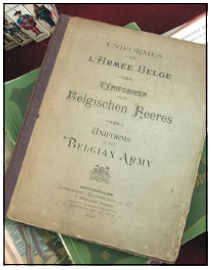
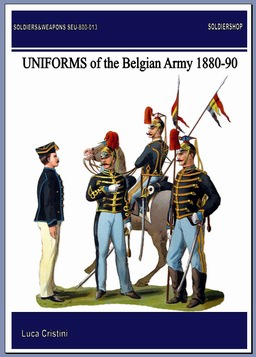
Well, luckily for me I happened across a slim title from the Soldiershop.com entitled 'Uniforms of the Belgian Army 1880-90'. It's more of an illustrated pamphlet than an in-depth study but it has the advantage of being an authentic period piece (re-published by the said online reference publisher).

Left: Originally published in 1893, the original pamphlet has been converted into an eBook by Soldiershop.com (Photo: Soldiershop.com)

This little book contains 12 colour lithographs featuring a total of 59 figures representing the cavalry, infantry, artillery, auxiliary and general staff of the Belgian army.

The illustrations are wonderfully quaint, but equally they are crisp and clear and give a good rendition of the colours of the various arms. Accompanying text is limited, I'm afraid, to one brief line per figure on the opposing page, giving the unit and rank of the soldier depicted. It's a great pity that this scant information has not been expanded on in some sort of supplement at the back of the re-publication, but beggars can't be choosers.
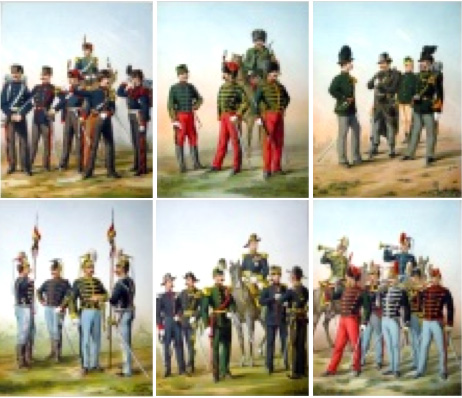
Some thumbnails of the plates showing the great diversity of uniforms
which typified a pre-WW1 European army, even one as small as the Belgian.
Picture source: Soldiershop.com
The reference that this little book affords me is greatly appreciated and will inspire, no doubt, some very creative and colourful toy soldiers for my army of Molatero! But most of all I greatly appreciated the price of this book...Gratis!

That's right, this eBook didn't cost me a penny.

Now don't ask me why, for as far as I could see this PDF download should have cost me 7.50 Euros - a price, I hasten to add, that I was more than happy to pay - but perhaps due to some strange glitch at the PayPal end of Soldiershop.com's shopping cart process I could not seem to complete the transaction. Hugely disappointed I abandoned my attempt to buy the item, but on checking my email this morning I found I had been sent a link to the download for this PDF in any case!

Bizzarre! (But, hey, I'm not going to complain!)

Soldiershop.com has some additional eBooks that interest me - mainly on the French army of my target period of around 1890 - so I may be tempted to try and see if the same glitch applies. ;)

But in any case, as I said, for such a niche publication the stated price of 7.50 Euro is definitely worth the paying...IF you can pay that is.

I couldn't resist including this picture of these beautiful toy soldiers...
Slightly later, but still an evocative example of how the Belgian army
entered into the Great War with an antiquated air. This dog-drawn Maxim
unit was made by Beau Geste typified the '19th century' influence that was
soon to be harshly eradicated in the murderous trench warfare of WW1.

Monday, 14 October 2013

Heavy gun team complete

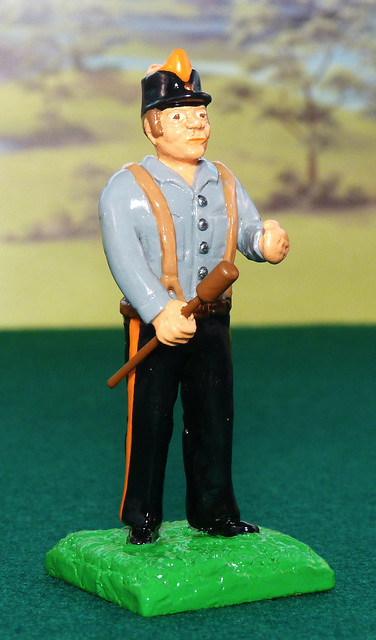
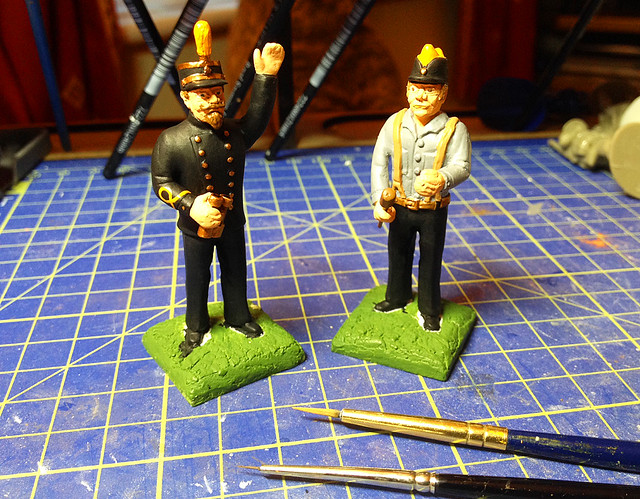
Huzzah! I have just completed my very first FLW unit! My Heavy Artillery team is all done and dusted and all that's left for me to do is do present them in all their glory. Phew!

Gilbert the Rammer!
Lt. Cuthbert - gunnery officer


I'm quite pleased with this set, I think Cuthbert in full uniform was the right choice as the contrast between the four characters makes the team look more authentic. I am definitely glad I went with this Belgian army inspired uniform - I was very impressed by some of the Belgian WW1 uniforms and I will be dipping into this reference source again no doubt.

I really have to give a mention to Black Hat Miniatures (UK) as the basic gun team figure is theirs, and it was a superb starting point for my conversion project. Big thank you to them.

Well, what now? I'll take stock and then decide which one of my back-log of projects to get on with - but finishing my first FLW unit has given me a bit of motivation. I hope you like them.

Coveted childhood toy soldiers

I was reading the very enjoyable 'Mannie Gentile: Toy Soldiers Forever' blog article about where his obsession with toy soldiers started and this put me in mind of the first time I really got excited and wanted to own my own plastic army.

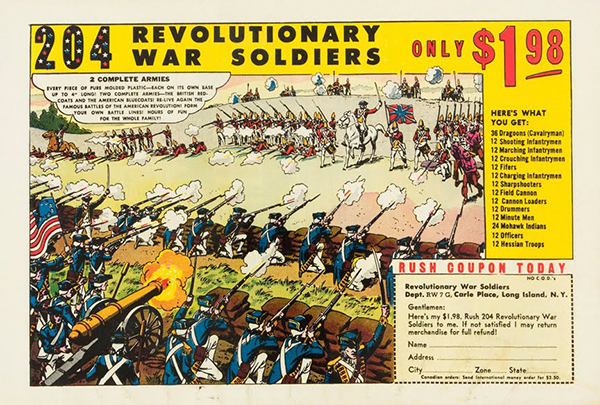
When I was very young I used to enjoy the American comics published by Harvey, in particular I was a fan of Casper the Friendly Ghost (I kid you not)! But what always used to catch my attention were those fantastic adverts for amazing toys that they had in the back of the comic...


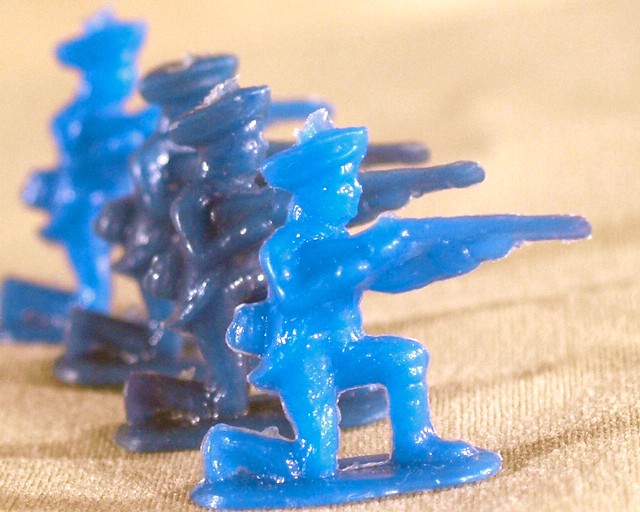
Oh, how I wanted those 204 Revolutionary War Soldiers! I would read and re-read the list of what was included and imagine how good the collection would look on my bedroom floor.

Of course I never got my grubby little hands on them and eventually forgot about just how much I REALLY needed them. But Mannie's post had me thinking about them again and I wondered if I could find any photos of what they actually looked like. Would they be as fantastic as I had imagined, or would they be as disappointing as I have since found out that many of the other 'amazing' toys were that were advertised in these American comics (like the child-sized Polaris Submarine which turned out to be little more than a cardboard box).

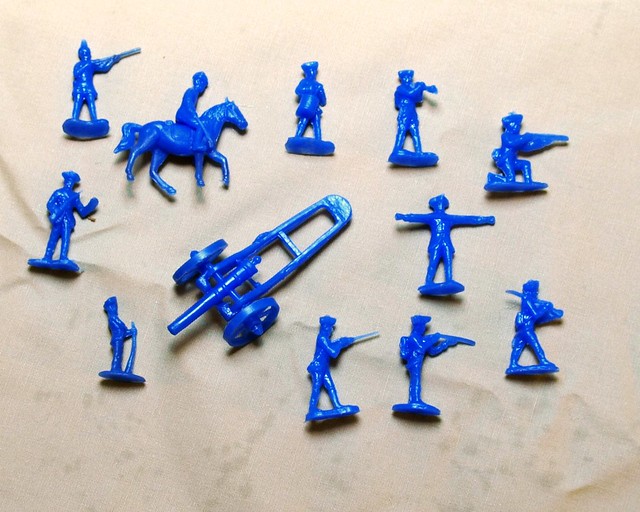
Well I eventually tracked dow a blog which unmasked the Revolutionary War Soldiers - 'Plastic Toy Soldier Pictures' has some nice photos which show exactly what you got for you $1.98...And it's pretty much what you might imagine you might get for that amount (though as a kid I still think I might have been mildly impressed, maybe)...


I guess the moral of this story is - don't revisit things you thought were 'amazing' as a child as you will invariably be disappointed!

Sunday, 13 October 2013

News from Scotland - metal casting practise

Thought it might be interesting to post up some of my brother's progress in his metal casting with Prince August moulds...


This 3 piece mould kit from Prince August produces a 54mm , 10 piece, white metal model kit of a 10th Hussars ( Prince of Wales Own) Kettle Drummer...

Although no specific date is given, the drummer is wearing a busby which was replaced by the Shako somewhere around 1812/13 and it was not uncommon for both styles to be worn by troopers in the same unit at the same time. This also applies to other uniform changes of the time, particularly the colours of the uniform trimmings. This model would be OK for a Napoleonic scenario.

It took some time and multiple failed castings to get the hang of it. The Lee production pot was a great help especially combined with a multimeter with a temperature probe which allowed me to play around with different temperatures as well as just getting used to the Lee pot.

The best castings were produced when:-

The moulds were preheated either by casting or by heating in the oven
The metal was in the range 320 - 395C when poured.
The insides of the moulds were well dusted with talcum powder.
The moulds were properly aligned and firmly clamped.
The mould was vigorously 'tapped' for 10 - 20 seconds while the metal was still liquid.
The casting was allowed to cool down properly before de-moulding.
Additional vents and reliefs were cut at critical points in the mould.

The moulds were quite good quality although the location of some of the sprues and the orientation of the pieces was questionable and in some cases ( especially the drum covers) they couldn't have located the sprue in a worse place. Even with a perfect casting, a lot of otherwise unnecessary work is needed to remove the remnants of the sprue right at the spot where the drum is supposed to locate. If they had just turned the covers upside down when making the mould there would have been no problem.

A descent start, I think, into metal casting and, based on the results from this second hand mould with some minor wear/damage, I'm confident that I can get some good castings from a new mould. I rather fancy the Prince August 54mm Napoleonic Cannon. (I might be able to flog some to that Molaterian rabble).

------

Nice stuff! I do like the Prince August stuff though I do find their catalogue of soldiers somewhat limited (and expensive). However, they do provide a great way to start your investigation into metal moulding with their range of 'beginners' kits.

Ian's done a lovely job here, particularly with documenting the process. His experience gathered from this practise casting means that when it comes to producing a metal 'Harry' he will be able to create the most efficient mould arrangement.

...So I better get my skates on and provide him with something to mould! :)

(And yes, Molatero would be very keen on acquiring some new cannon!)

Saturday, 12 October 2013

Heavy gun crew nearly complete

I'm just putting the final touches to the last two of my Molaterian heavy artillery crew. I wasn't sure if the all black uniform of the officer would work, but I can now say that I'm very pleased with it...


Hardest part was carefully painting on the officer's cuff rank insignia. Boy, do I have wobbly hands!

...Soon have my very first completed Molaterian unit! (Albeit probably one of the smallest.)