Showing posts with label In books. Show all posts

Wednesday, 7 March 2018

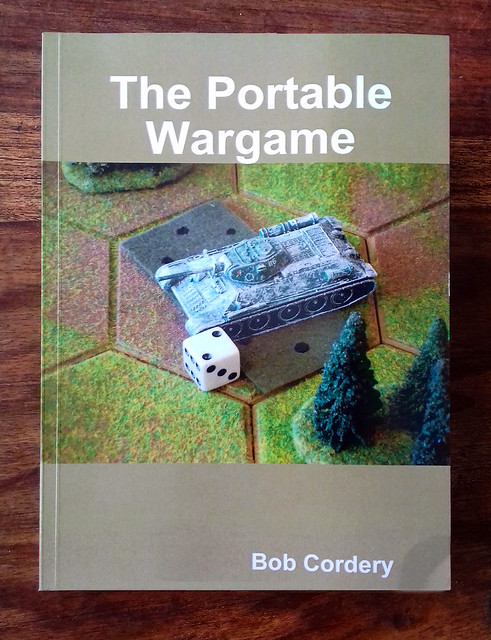
The Portable Wargame Rule Book

I've been hearing things about this simple rule system for a few months now and it sort of piqued my curiosity. You see I'm not a ver good war gamer, I struggle with most rule systems even if they are advertised as being 'easy and quick to learn'. I just seem to have a mental block (it's the same with D&D, try as I might - and I'd love to play it - my brain just zones out when someone starts to explain to me the rules)...

Anyway, I happened upon a piece on the 'Little Wars Revisited' blog where they had setup a demonstration game based on Bob Cordery’s 'Poratable Wargame' rules...I was captivated!

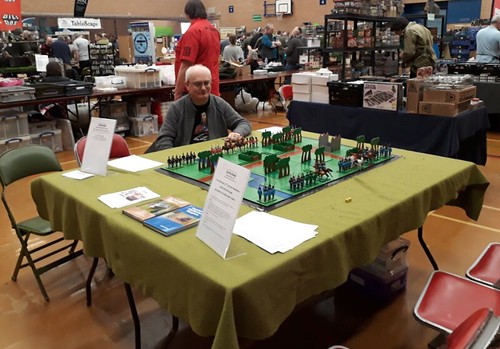
The chaps from the 'Little Wars Revisited' blog setup a wonderful rendition of the
Portable War-game at the Cavalier Wargames Show in Tonbridge, Kent in Feb 2018.
 The figures were 54mm scale and the scenery was scratch built...Superb!
Picture credit: Mike Lewis - the 'Little Wars Revisited' Blog

I immediately did some Googling and found 'The Portable War-game Website' which give a very nice little history of the development of the rules as we as the rules themselves...


Although this resource is all you might need to get the gist of the rules and get you started, I am a bit of a traditionalist and like a book sat in from of me when learning new things. So I nipped over to Amazon and blew a Fiver on Bob Cordery's book on his game. This arrived today...


I was pleased to note that the book fleshes out some of the concepts discussed on the website, and - furthermore - gives some very interesting 'game reports' which show the rules in action.

Another nice thing is that these rules aren't just for the 'Funny Little Wars' (19th Century Armies) enthusiast, the rules cover various different types of warfare from several different historical periods. Really the rules are just a framework from which you can customise and include your own interests - there is no reason, for example, that you cannot conduct a science fiction or fantasy warfare battle using Bob's rules.

However, I am - it so happens - interested in 19th Century military campaigning and the idea of a short format game which is able to fit on the dinning room table appeals to me. I also like the idea - discussed in the book - that the rules can be modified to facilitate solo play!

I'd really like to make a couple of 'peg' armies and have them battle it out using these rules.

Saturday, 3 October 2015

Library additions for October 2015

Aside from the collecting and painting of figures my FLW hobby has lured me into becoming something of a (very) amateur historian of all things 19th and very early 20th century. I've collected a small library of books which cover military campaigns from the Franco-Prussian war (1870) to the Balkan Wars of 1912, mostly reference works about uniforms of the period.

This months additions to my library are rather niche and interesting - I think - and add to the range of scenarios that the FLW player can field.

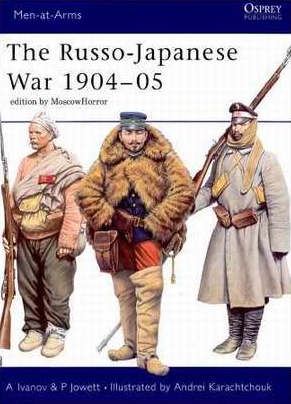
Osprey's The Russo-Japanese War 1904–05
This is rather topical for me as part of last months pay day treat was my purchase of some Japanese
soldiers by The Virtual Armchair General, so it's interesting to read about a campaign in which these soldiers could be used (from a war gaming point of view). That's not to say I intend to expand my collection of TVAG figures or to war game with them, it's just interesting to have some historical context for the TVAG Japanese.

Additionally, I found it very intriguing to read about a war which is not so well know - at least here in the West. The Russo-Japanese War of 1904 is consigned to the bottom draw of Edwardian era campaigns mainly because it's 'not European' (as we have this tendency to get a little confused about whether Russia is European or not). Furthermore, we tend to be a bit snooty about the idea that a non-European nation - like Japan - could be modern enough (in the context of the 1900s) to merit the same attention as a European or American army of the same period...

Well, as it turned out this was exactly the same sort of misconception that the Russians appeared to be under and boy did they pay the price for their ignorance of the real facts!

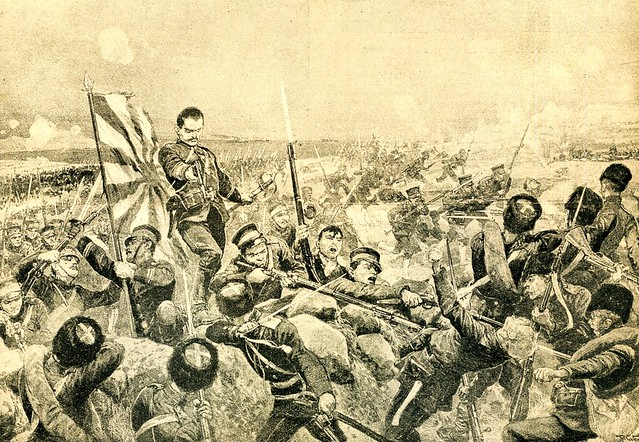
Japanese assault on the entrenched Russian forces, 1904. Source: Wikipedia
Wikipedia entry (should you wish more information): Russo-Japanese War

In actuality, as some of us might be aware - as is related in the excellent movie 'The Last Samurai' - the Japanese enthusiastically embraced Western style modernisation in the mid-19th century and by the 1900s had a very modern and technically sophisticated military. Not only were the Japanese as technically up-to-date as European armies but they showed themselves to be extremely adept in all the latest military theory and strategy as well...Hence Russia's hugely humiliating and unexpected defeat.

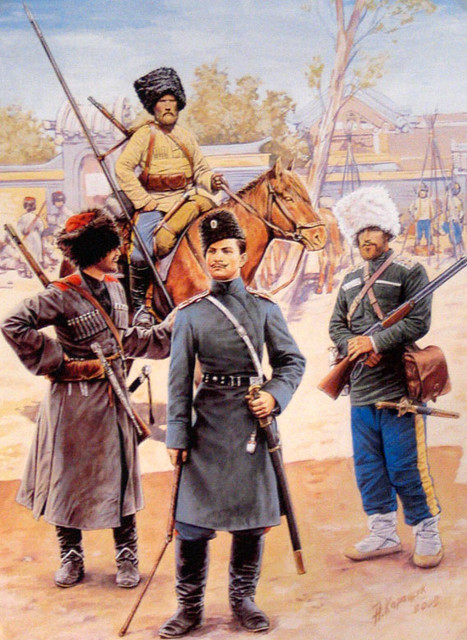
Left: Plate from Osprey's book. As much as my emphasis has been on the Japanese involvement the book has some wonderful illustrations of Russian forces. What FLW general wouldn't want a squadron of these Cossacks? Source: Osprey

The Osprey book has - as usual - some wonderful colour plates of the uniforms in use by either belligerent during the war. And it's interesting to note that the Japanese of this time went through the same transition in uniform styles that their European counterparts did just prior to The Great War - from brightly coloured 19th century styled garb to the more subdued 'earthy' 20th century attire.

From an FLW point of view this book would make an ideal companion to AiP's Japanese and Russian plastic soldiers.

MEN-AT-ARMS 414
Author: Alexei Ivanov, Philip Jowett
Illustrator: Andrei Karachtchouk
Short code: MAA 414
Publication Date: 25 Jul 2004
Number of Pages: 48

Link to the book at Osprey's web site: The Russo-Japanese War 1904–05

A World Aflame - Interwar Wargame Rules 1918-39
My second Osprey book this month isn't about uniforms nor, indeed, strictly speaking the classic FLW period. Rather 'A World AFlame' deals with war gaming the inter-war period of 1919 to 1939.

While not strictly a war gamer - let's just call me 'war game curious' - I do find the notion of playing out some of the inter-war scenarios fascinating. It's a very exciting period in my opinion, one which was dominated by the initial clashes of the two giant ideological systems of the age - socialism and fascism. Or, as Osprey puts it:

"A World Aflame captures the adventurous nature of the time period to present a fun, fast-paced set of tabletop miniatures rules that can handle the many diverse conflicts of the period, from the Chinese Civil Wars and the "Great Game” in Central Asia, to the Irish War of Independence and the bitter ideological warfare of the Russian and Spanish Civil Wars."

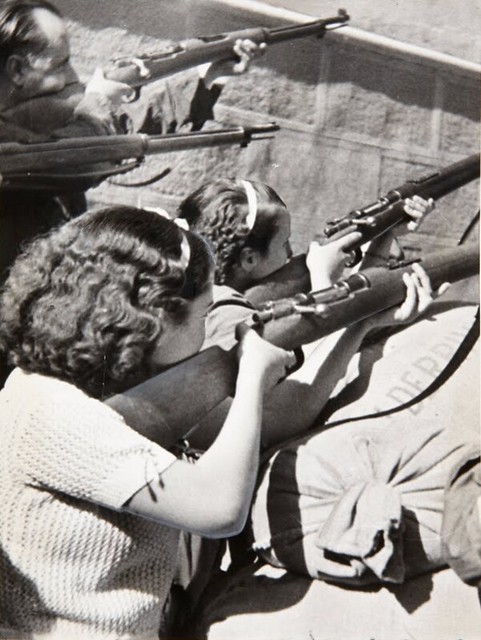
Left: Women at the Siege of the Alcázar in Toledo, 1936. The Spanish Civil War was but one of the conflagrations of the inter-war period, but it epitomised the growing blurring of the lines between civilians and combatants. Source: Wikipedia

Whether you see this era as the pre-amble to The Second World War (and bear in mind that the Chinese see the start of WW2 as when Japan invaded them in the mid-1930s and not in 1939) or as a revolutionary period or as one of the last great ages of adventure, the inter-war era is a vast resource of 'peculiar wars'. I say peculiar as - at least to me - a proportion of the conflicts of this time were more focused on the involvement of the general populous and their aspirations rather than the sabre-rattling imperialism of the previous century.

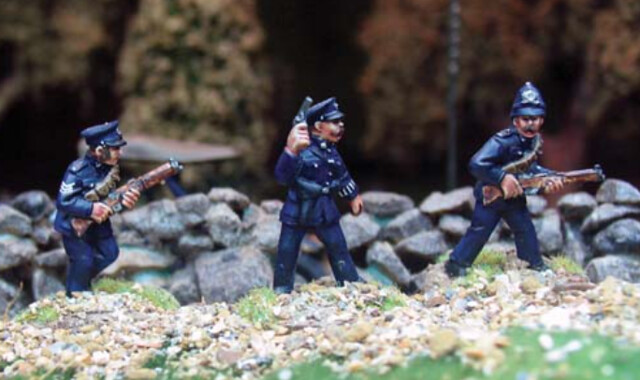
'British Bobbies on Patrol'. This photo from the book illustrates the greater
emphasise there is on irregular, civil and militia forces as belligerents in the
game. Source: Osprey.
Furthermore, I am somewhat intrigued to see how a set of war game rules will capture this aspect of the inter-war conflicts, involve the civilian populous and make provision for popular uprisings and ideological warfare. I'll give my thoughts on this once I've had a good read of the rules.

I am hoping that these game rules can shoe-horn into the actual FLW game rules as a means to expand the basic flexibility of the game. Another option might be to look at Solway's 'A Very British Civil War' gaming rules.

A World Aflame
by Paul Eaglestone
OWG 2
ISBN: 9781849086837
Order ID: 100169343

Link to the book at Osprey's web site: A World Aflame - Interwar Wargame Rules 1918-39

Tuesday, 22 September 2015

The Funny Little Age - A 19th Century History

Audiobook: The Long 19th Century: European History from 1789 to 1917 by Narrated by: Professor Robert I. Weiner [Warning: Rambling monologue ahead!]

A Funny Little source-book!
One of the great attractions, I think, of H. G. Wells's Funny Little Wars as a form of and theme for war gaming is the quaintness and varying state of obsolescence integral to any army of the Victorian or Edwardian period (the era which  was the subject of H. G. Wells's original game).

There is something quite fascinating about the political, social and technological dichotomy of this period - the 19th century - as perhaps more than any other century the pace of modernity and the juxtaposition of the old and the new was acute and jarring. The great industrial revolution of the previous century had catapulted Europe into a new golden age of invention the like of which had never been seen before, but unlike previous ages of innovation the effects of this new 'modern' age were felt all the way down and more largely to the lowliest citizen.

In the past change had - on the whole - been slow and gradual and where the difference between one century and the next in terms of technological and scientific progress was bearly perceptible. The 18th and 19th centuries, on the other hand, saw an unprecedented acceleration in discovery where social, cultural and political attitudes were struggling to keep pace with innovation and implications of  the new mechanisation.
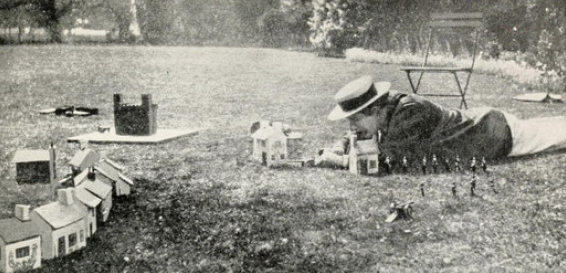
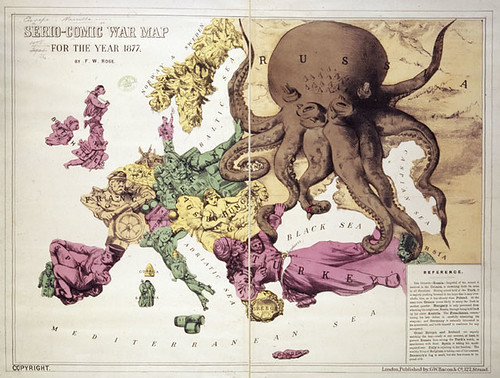
19th Century Geo-Politics according to H. G. Wells. But the 'boys and their toys'
mentality was not far from the truth in the way Europe harnessed industrialisation
as a major tool in it's imperialistic ambitions.

Perhaps nowhere else was the clash of tradition and the modern so apparently at odds than in the military.

The 19th century could be seen as the transition between the grand old Regency world and the modern. Conservative attitudes appeared still firmly Napoleonic while innovations sought to pull military philosophy into the 20th century.

This is the backdrop to the world of Funny Little Wars, the miniature battlefield where regiments still largely appeared dressed as they might have at Waterloo but where also the weapons technology was very much a sinister precursor to the Great War of 1914 (the disastrous watershed that was the final nail in the coffin of the Edwardian Period).


All this leads me (finally) to this month FLW related reading matter - or rather, as usual in my case, 'listening matter' as it is an audio book.

To begin with this isn't a book at all (audiobook differentiations aside) but rather this is a series of academic lecture. This audio-lecture (then) is a part of a series of 'books' which come under the title 'The Great Courses'. A scholarly collection of lectures on history intended for college/university level students and amateur historians, and as such they might be just a wee bit dry if you are used to the rather more mainstream 'populist' history works.

This is very much like attending a college lecture and it's all very matter of fact, but as this is a subject that doesn't get a lot of airing - as most historians tend to be either interested in the Napoleonic preamble to this period or the culmination of The Great War - treatise of the 19th Century as a whole are a little thin on the ground.
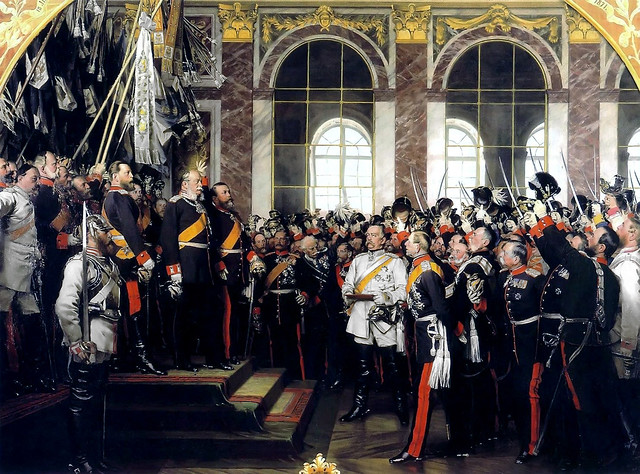
Anton von Werner's depiction of Wilhelm's proclamation as Emperor in the Hall
of Mirrors in Versailles; Bismarck is in the centre-right wearing white. While it's
easy to type-cast the Germans as the quintessential 'baddies' of the 19th Century in
truth practically every major nation played their version of  'The Great Game'.
[Picture source: Wikipedia]

I know that there are spots of military history which belong to this period that do have ample coverage by historians, The Crimean War (1853-56) The Franco-Prussian War (1870-71) and The Boer Wars (1880 to 1881 and 1889 to 1902) are popular subjects but otherwise historians tend to treat the century as the waiting room for the First World War! That's my personal opinion - but it's my experience that historians don't seem to be very interested in peacetime armies.

Anyway, so Professor Weiner's (yes, I know) collection of papers on the subject of the 19th Century is quite enlightening and good background material with which you can better understand the context of H. G. Wells's FLW hobby. You will be introduced to historical characters like Otto von Bismarck, and Kaiser Wilhelm II, the archetypal 'baddies' which so influence Funny Little Wars an it's scenarios and you will get a sense of the sort of political and diplomatic intrigue that influenced Anthony Hopes 'The Prisoner of Zenda'!

I can't exactly describe this 'book' as entertaining, but as a reference sourcebook for FLW 'plotting' it is very informative and useful. Here are just some of the titles of the lectures included in this work:

• The Napoleonic Era, 1799–1815
• The First Industrial Revolution, 1760–1850
• The Crimean War, 1853–1856
• Age of Bismarck—Creating the German Empire
• The Third Republic—France, 1870–1914
• Russia, Turkey, and the Balkans
• The “New” Imperialism European imperialism from the 1880s until about 1905

Link to the volume in the Audible Library:  The Long 19th Century: European History from 1789 to 1917

Written by: The Great Courses
Narrated by: Professor Robert I. Weiner
Length: 18 hrs and 28 mins
Series: The Great Courses: Modern History
Sunday, 16 February 2014

Lycra not required! 54mm cyclists

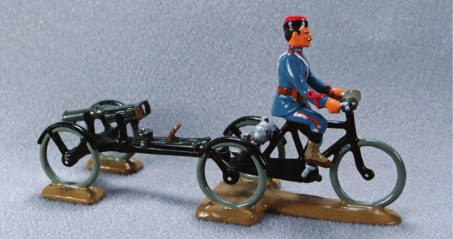
Perhaps a little late but here's a little heads-up on a nice article in February's edition of 'Toy Soldier & Model Figure'. Written by James H. Hillstad, 'The Bicycle in War and Peace' sketches out a rough history of the bicycle in civilian and military use


I know it's amusing to think that bicycles were, in fact, taken so seriously by the military at one time, but practically every major nation at least investigated the idea of a bicycle unit as a cheaper and easier alternative to cavalry. Many invested heavily in the new-fangled contraption in order to increase the mobility of their infantry regiments. Indeed, until motor transport finally replaced horses wholesale during the Second World War bicycles remained one of the most cost effective ways to move troops around (when movement by rail was impractical).


I am very interested in this notion, particular where the bicycle was utilised as a means to transport heavier team-crewed weapons like the Maxim. Mr. Hillstad's use of toy soldiers and figures to illustrate his history of the bicycle is delightful and is an inspiration.

My copy of 'Toy Soldier' was bought from PocketMags.com as I like to have my magazines available for various devices and have to option to print out articles if I wish.

Friday, 8 November 2013

Toy Soldier Magazine - Review Oct 13 edition

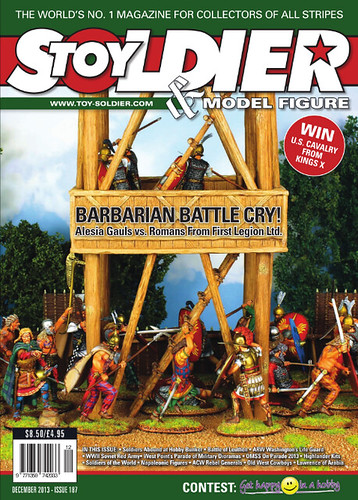
I've been involved in many different hobbies in my time, in fact I sometimes think that hobbies are my hobby, and in whatever pastime it is that I am engrossed in I like to buy a copy of one of the printed magazines that cover that occupation. Collecting and painting (and making) toy soldiers is no exception but supporting journals are a little thin on the ground unfortunately, luckily the one publication I have found is a very good one.

Toy Soldier & Model Figure magazine is a monthly magazine and this month it's 76 pages feature a whole host of miniature soldiers from a variety of periods, with it's featured articles covering subjects like; 'Battle of Leuthen [1757] diorama', 'West Point's Parade of Dioramas', and a wonderful centrefold photo piece on a WW2 British Commando raid diorama. Side from these there is a wide selection of updates on the latest toy soldier collectables that have come onto the market.

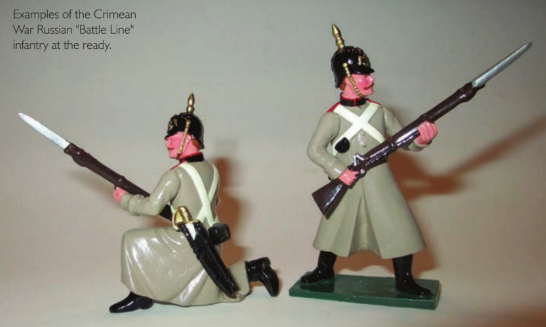
Soldiers of the World manufactured Crimean War Russians
I like the variety of subject matter, periods and types of 'toy soldiers' that is covered even though I, of course, am mainly interested in subjects that are pertinent to Funny Little Wars. I also appreciate that it's not all about premium metal 'collectables' - there is a regular page just for the latest plastic figures and they even have a slot for those that enjoy 1/6th figures (that's 'Action Man' to you and me)!

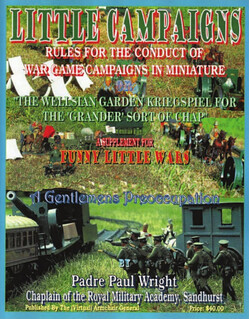
However, this month is especially entertaining for the FLW fan as they include a look at the latest FLW publication - 'Little Campaigns' - on their main book review page.

I suppose FLW and wargammer hobbyists might baulk at the niche focus specifically on soldiers (though some vehicles are also tolerated to a degree) but I love to see what's new on the market and Toy Soldier - it seems - is the de facto international shop window for manufacturers, big and small. There always seems to be something that catches my eye or that gives me an idea - and in any case, who doesn't like looking as toy soldiers? 

Finally, I should mention how I get my copy of Toy Soldier. As mentioned it is a printed magazine and can be gotten via the normal channels - either from your newsagent or by direct subscription - but I prefer to read a digital format that is available from www.pocketmags.com - as it means I can read my copy surreptitiously on screen during working hours!

Cost is £4.95, which - when I compare it to some of the hobby magazines I have purchased - isn't too bad, but for some reason there isn't a subsidy for the digital version, in fact its 4p dearer!

'King and Country' manufactured metal Turkish Staff Car - lovely!
Picture Credits: Toy Soldier & Model Figure

Monday, 21 October 2013

Even more uniform reference books - for free!

Reference material is like buses, you can't get any for ages and then a load comes at once! (Sorry, I couldn't resist regurgitating that old chestnut!)

I happened to be doing some late night surfing, just tootling around not looking for anything in particular, when I came across the 'Italian Society of Military History' web site. It's in Italian - naturally - so it was quite a feat of luck that I came across their download section (thank goodness for Google Chrome's translate feature)!

The site has a pretty large PDF archive, the contents of which is offers FOR FREE. I didn't expect much so imagine my surprise when I came across Koppen's 1890 'Armies of Europe' and the NYPL - Vinkhuijzen Collection's 'Uniformi Svizzere 1875-1909'!

Now, as far as I understand both of these antique publications are now in the public domain having been out of publication for well over 100 years, so I was happy to make use of this resource and downloaded...

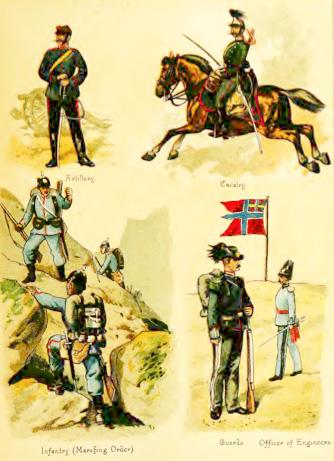
Koppen's 1890 'Armies of Europe'
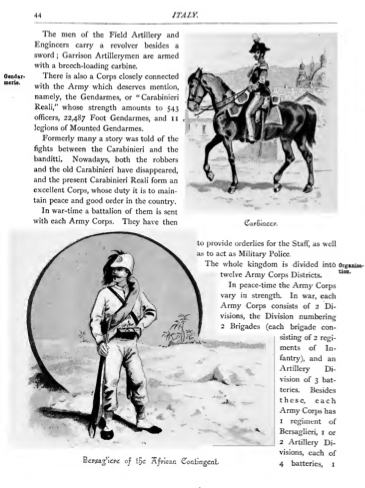
Actually, although - of course - the quaintly illustrated colour plates are very welcome this book has wealth of period text describing the disposition and organisation of the armies that it covers. These include; Britain, Germany, Austro-Hungary, Italy, France, Russia, Denmark, Sweden and Norway, Spain and Portugal, Switzerland, Holland and Belgium and Turkey and The States of the Balkan Peninsula!

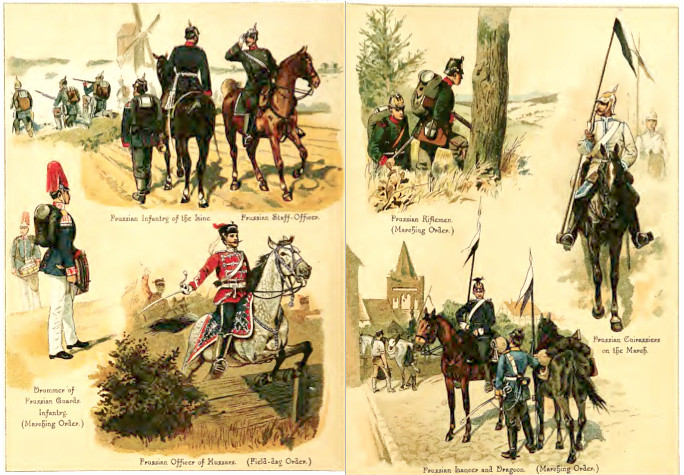
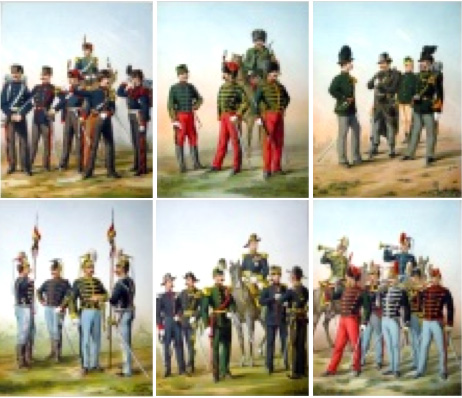
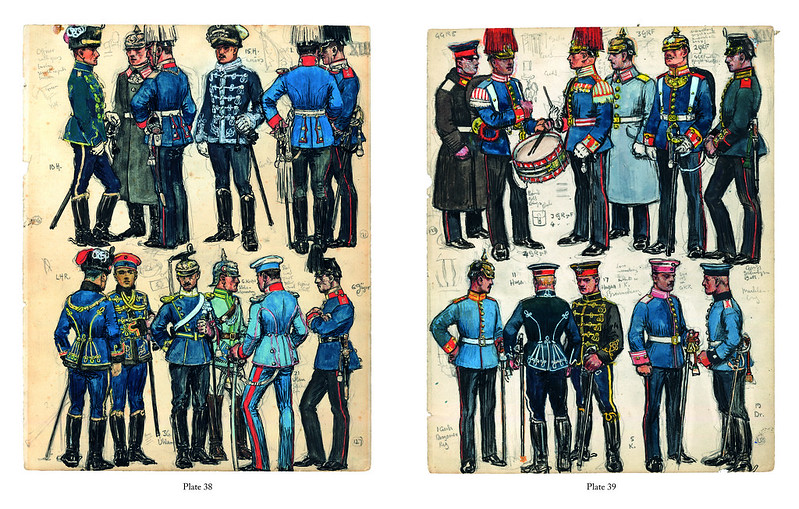
To be honest, the colour plates are not the best illustrations I have seen - I'm almost tempted to say that they are intended for a younger audience - and to make matters worse whoever scanned this publication did so rather amateurishly and the plates are rather dark (hiding some of the more subtle colours). The example plates I have included here have been Photoshoped by myself to enhance brightness, contrast and vibrance and are now a little more useful.

One of the colour plates for the German army. All together - Boo! Hiss!

However, I was very pleased that the publication included a few armies that are not usually covered and in particular appreciated the fact that the Scandinavian nations were represented.

Norway! Huzzah!

As mentioned, the monochrome printed pages are just as useful, I think, and these include some charming line drawing as well. The PDF includes some 172 pages but a rather nice 'added bonus' were the amusing Victorian advertisements included at the back of the book!

All in all, this is a wonderful volume and definitely fills in some of the reference holes that modern material leaves in the history of European uniforms of the period.

Koppen's 1890 Armies of Europe - PDF direct download link


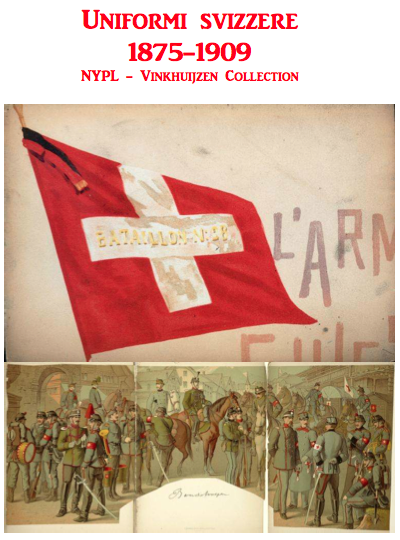
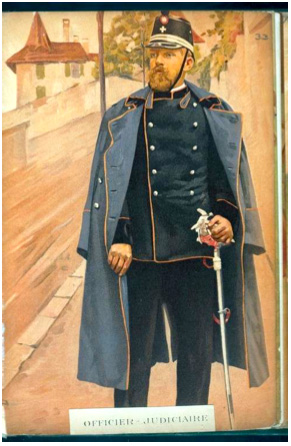
'Uniformi Svizzere 1875-1909'
Ah, Switzerland! Cookoo clocks and chocolate...And home of one of the damn finest armies in Europe!

No, these sturdy chaps didn't see any action in the 19th/20th centuries, but that didn't stop them becoming one of the more modern, professional and well equipped armed forces on the continent. For sure, if anyone had infringed their neutrality then they would have payed a very high price for doing so.

But anyway, Switzerland - or Army Red and White to put it in Funny Little Wars terms - is a wonderful subject for a book on uniforms as they really do turn out a smart body of men.

The book - some 45 pages long - is actually more of a pictorial study or collection of period lithographs. There is no accompanying text other than some very short captions within the illustrations themselves. But what illustrations!

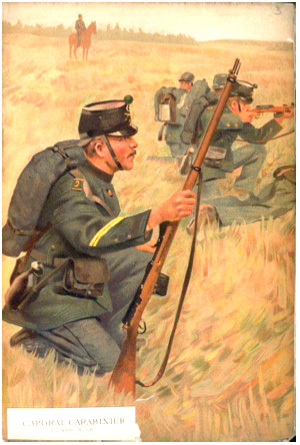
The rifle is the 1889 Schmidt-Rubin in 7.5×53.5mm.
Unusually for the time it had a 12 round capacity.

The artwork in this collection is absolutely wonderful, realistic, full of character and a delight in detail. It includes individual figure from most organisational arms, each captured in what looks like manoeuvres in the field. It's all very atmospheric and dynamic and - unlike 'Armies of Europe' has been scanned with some degree of expertise.

As well as a glorious reference tome these colour plates would look very handsome indeed in picture frames, they are that attractive. But the real joy of well drawn illustrations like these is the level of detail when it comes to the uniforms, there is little room for doubt as every uniform is captured accurately.


The Swiss army may be something of a niche subject - although I can think of at least one of my readers who will be very pleased with this book - but one cannot help but being very impressed with these superb illustrations.

'Uniformi Svizzere 1875-1909' - PDF Direct download link

My thanks goes out to the Italian Society of Military History for making these publications available freely to it's visitors. You can see it's full download archive here: SocietĂ  Italiana di Storia Militare - ARCHIVIO LIBRI IN REGALO
Sunday, 20 October 2013

Vive la différence!


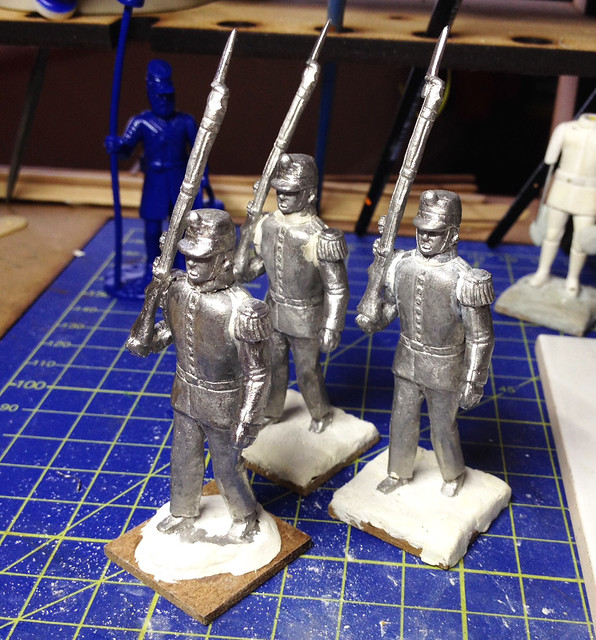
Between project tasks I've been slowly assembling some of my 1/32 Black Hat metal French Infantry of the Line figures. They are a nice change of pace from the intense concentration I've been doing with my sculpting project.

The other good thing about this French side project is that it isn't a long term project as I don't intend these figure to be used as a core of some French inspired FLW army. They are a stand-alone set I'm just doing for some fun. (I do have a metal 'Horizon Blue' FLW in mind, but this will be based on the rather smaller '54mm' figures of Dorset and Irregular miniatures. This project is a long term idea and is just in the 'collecting phase' at the moment.)

Any way - Vive la différence!

I do really like the Black Hat '54mm' range - though they are of the larger end of the 54mm spectrum (what I call 1/32 to help differentiate them). They wouldn't be compatible with vintage Britains toy soldiers, for example.

One other thing about the Black Hat range is that it is rather limited. They have a selection of these marching infantrymen and officers, but aside from their artillery team figures they so not have a great variety in poses and supporting characters. So, if you want to build an army based on the Black Hat figures you would have to be prepared to do a fair amount of conversion in order to be able to portray the many types of troops you need.

Anyhoo, it seems this weekend's theme is trying something different as while visiting York yesterday I picked up a little book that is rather off-piste for me.

The paperback reference book is by a company called G.I. and is in the vein of Osprey's reference publications. Called 'Fix Bayonets: U.S.Infantry from the American Civil War to the Surrender of Japan' it's an illustrated history of American uniforms which encompasses the time period that most interests me - 1890-1910 (though the book, in total, covers a period from 1865-1946).
I have never really been bitten by the American Civil War bug and American military history as a whole is a bit of a yawn to me, BUT the one era I do find of interest is my target era when America looked more externally and dallied with what can be described as a 'colonial' state of mind. From the Spanish-American War to the Boxer Rebellion the United States seemed to fall in-line with the other great powers and this was also true of their uniforms.
Although the US Army retained a distinctively American style to their dress, but at least in their 1881-1900 dress uniforms they assimilated a distinctly European influence which perhaps suggested a dalliance with the idea of competing on a global stage before they once again returned to their inward looking politics prior to the First World War.

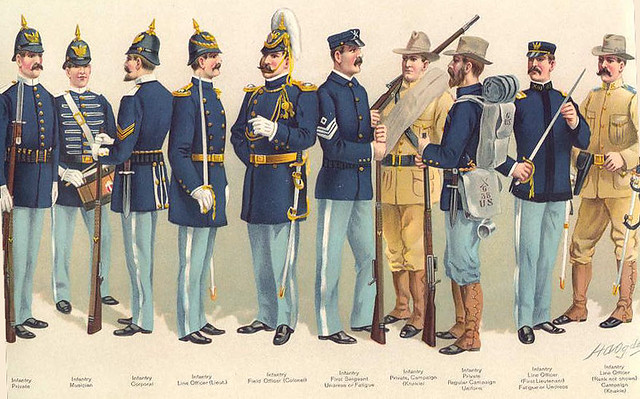
Circa 1899 - this lovely colour plate from the G.I. book shows a good
selection of US rank and officer dress and campaign uniforms.
Source: G.I. Books - see links below.

Of course the above idea is only my own opinion, but from the point of view of an exponent of Funny Little Wars it seems to me that this short window of time would be the ideal time on which to base a Army Red/White/Blue.

The book itself does not have the series of specially illustrated colour plates that the Osprey reference books have but rather has a small selection of period colour lithographs and photographs at the beginning of the book. The rest of the publication is a chronographic record of the uniforms of the US Army by means of original monochrome photography.

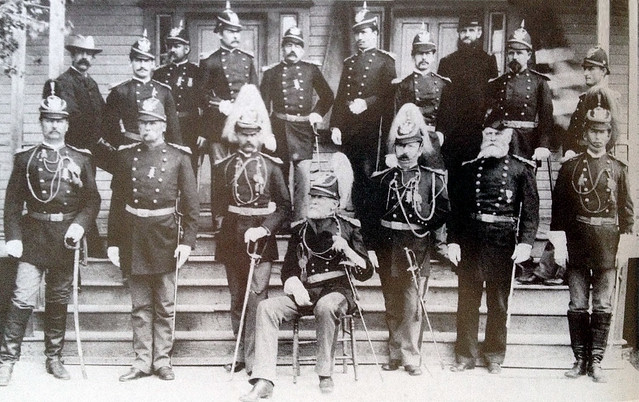
Officers of the 17th US Infantry c. 1884 - note the almost Teutonic look
of the officer bottom left!
Source: G.I. Books - see links below.

Commentary, such as there is, is restricted to the short captions which accompany the photographs. I was left with a feeling that I wanted to know more and so, ironically, might look into whether Osprey do a similar reference book!

The G.I. publication is more of a complimentary item if you are researching the subject and the period, and would - I think - be a very useful companion volume to something like an Osprey 'Men at Arms' book.

Still, for just £5 (second hand from Barbican Books) it is a very entertaining - and educational - booklet. I was unaware of just what the United States was 'up to' during my favoured 1890-1910 period of time. The collection of photographs are excellent and I might even be tempted to seek out the relevant G.I. cavalry volume which covers the same period.

Relevant links:

> Black Hat Miniatures (UK) - 54mm toy soldiers range

> Greenhill Books (for G.I. Books in UK)

> Stackpole Books (for G.I. Books in USA)

> Barbican Bookshop York - a lovely little treasure trove of second-hand books.

Tuesday, 15 October 2013

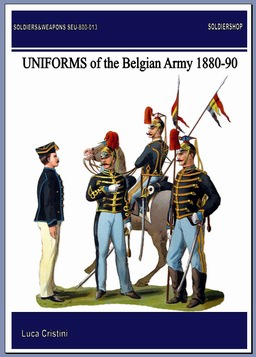
eBook: Uniforms of the Belgian Army 1880-90

As mentioned a few times over the past couple of weeks I am somewhat consumed by the history of the Belgian army at the turn of the 19/20th century. However, like so many military themes set in the 'hiatus' period between the end of the Franco-Prussian War and the start of World War One getting good reference material is something of a problem*. Publishers like Osprey, for example, just do not seem to be interested in the organisation of armies during peace time periods, their attitude seems to be that if there is no conflict or campaign military enthusiasts are just not interested!

*Of course there was the Boxer Rebellion and some colonial action, including the Boar War, but otherwise this period - between 1871 and 1914 - seems to be a period of preparation for The Great War!

Anyway, thus far the volumes of greatest use to me have been Haswell Miller's 'Vanished Armies' and Osprey's 'The Belgian Army in World War 1', both of which - of course - focus of the build up and early years of The Great War. However, they do include a interesting insight into the way that European armies transitioned from the Edwardian peacetime uniforms into the drabber battledress of trench warfare.

Liebig S608 Belgian Military Uniforms 1899  - these collectors cards were
given away with their beef extract! Hey, I'll take reference where I can get it!
Picture source: Cigcardpix Flickr album

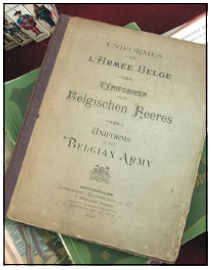
Well, luckily for me I happened across a slim title from the Soldiershop.com entitled 'Uniforms of the Belgian Army 1880-90'. It's more of an illustrated pamphlet than an in-depth study but it has the advantage of being an authentic period piece (re-published by the said online reference publisher).

Left: Originally published in 1893, the original pamphlet has been converted into an eBook by Soldiershop.com (Photo: Soldiershop.com)

This little book contains 12 colour lithographs featuring a total of 59 figures representing the cavalry, infantry, artillery, auxiliary and general staff of the Belgian army.

The illustrations are wonderfully quaint, but equally they are crisp and clear and give a good rendition of the colours of the various arms. Accompanying text is limited, I'm afraid, to one brief line per figure on the opposing page, giving the unit and rank of the soldier depicted. It's a great pity that this scant information has not been expanded on in some sort of supplement at the back of the re-publication, but beggars can't be choosers.

Some thumbnails of the plates showing the great diversity of uniforms
which typified a pre-WW1 European army, even one as small as the Belgian.
Picture source: Soldiershop.com
The reference that this little book affords me is greatly appreciated and will inspire, no doubt, some very creative and colourful toy soldiers for my army of Molatero! But most of all I greatly appreciated the price of this book...Gratis!

That's right, this eBook didn't cost me a penny.

Now don't ask me why, for as far as I could see this PDF download should have cost me 7.50 Euros - a price, I hasten to add, that I was more than happy to pay - but perhaps due to some strange glitch at the PayPal end of Soldiershop.com's shopping cart process I could not seem to complete the transaction. Hugely disappointed I abandoned my attempt to buy the item, but on checking my email this morning I found I had been sent a link to the download for this PDF in any case!

Bizzarre! (But, hey, I'm not going to complain!)

Soldiershop.com has some additional eBooks that interest me - mainly on the French army of my target period of around 1890 - so I may be tempted to try and see if the same glitch applies. ;)

But in any case, as I said, for such a niche publication the stated price of 7.50 Euro is definitely worth the paying...IF you can pay that is.

I couldn't resist including this picture of these beautiful toy soldiers...
Slightly later, but still an evocative example of how the Belgian army
entered into the Great War with an antiquated air. This dog-drawn Maxim
unit was made by Beau Geste typified the '19th century' influence that was
soon to be harshly eradicated in the murderous trench warfare of WW1.

Monday, 5 August 2013

Vanished Armies

I have read about several Funny Little Wars enthusiasts that have enthused about A. E. Haswell's ‘notes and memories of the days before “the lights went out in Europe” in the year 1914’. The book contains beautifully sketched illustrations of uniforms worn by a variety of European nation's armies of the period 1908-1914.

The work was done by A. E. Haswell - a Scottish artist and soldier - while he partook in a grand tour of Europe in the years prior to the outbreak of The Great War.

I picked this book up on Amazon Marketplace for less than £10 and it is very well worth the price. As a graphic artist what I find fascinating is not just the wonderfully charming sketches themselves but also the little doodles which surround the main plates of details of interest.

Another reason that this book is so valuable for anyone interested in uniforms of this period - which I should think would be the majority of Funny Little Wars enthusiasts - is that it includes some of the nations who were not directly involved in the then looming war of 1914-18.


Normally modern books about uniforms tend to be campaign or conflict based, surmising that most 'military enthusiasts' are interested in war. As such those nations which did not take part in conflagrations are likely to be overlooked and their forces, their uniforms and formations have faded away and are generally undocumented. So it is nice to see countries like Spain, Portugal and Sweden being represented in Mr. Haswell's book.

The colour and variety of uniforms, even within one nation's army, are a delight to behold and this is sure to be a font of inspiration for any FLW 'Field Marshal' who is mustering his forces!

Vanished Armies by A. E. Haswell available from Amazon retailers

Saturday, 13 April 2013

In Books - The First to Land

I've just finished Douglas Reeman's second book in the 'Blackwood' series, a good old fashioned rip-roaring adventure series about the Royal Marines. This instalment has as it's background the 1900 Boxer Rebellion and sees the 'Royals' with their backs against the wall  as they attempt to hold out against waves of fanatical Chinese.

The main action in the book takes place during the historic siege of the city of Tiensin.

British and Japanese soldiers depicted fighting Chinese forces during the
Battle of Tientsin. This is the very action described in Reeman's book, in fact
he mentions the Japanese holding the ground next to his hero's Marines.
Image source: Wikipedia 

Aside from being terrific background material for your Funny Little Wars Reeman's story harks back to 'stiff upper lip' style of fiction that is gripping escapist reading. I found his style reminiscent of a grown up man's 'Commando' comic, but before I give the wrong impression I should say that while the action is thick and fast Reeman's research and military knowledge is masterful.

I have read several other of Reeman's books, he specialises in naval novels and I particularly enjoyed his World War 2 stories like Winged Escort and Torpedo Run. But The First to Land puts me in mind of the 1963 film '55 Days in Peking' and is very much in the vien of pro-colonialist heroism - like 'Zulu' - where the 'civilised' Europeans (and their alies) triumph in the face of hoards of 'barbaric natives'.

Left: '55 Days in Peking' is one of my favourite movies. David Niven is stiff upper lip-ness personified in this big budget production which has a lot in common with Reeman's book, including a suspiciously similar love interest!

I garnered a lot of interesting information from the story which I will apply to my Funny Little Wars collection and it has ignited an interest in the multi-national alliance that was pitted against the Chinese, an ironic example of international cooperation considering the events which were to unfold in the following years leading up to 1914.

If I have any criticism of Reeman's books it is the inevitable 'love interest' that he shoe horns in. I'm sorry, but a bit of romance in my war stories just doesn't float my boat! Luckily he tends to keep these uncomfortable diversions brief.

Troops of the Eight nations alliance against China 1900. Left to right: Britain,
United States, Australian, British India, Germany, France, Austria-Hungary,
Italy, Japan. Image source: Wikipedia

So, don your sun helmet and wax your moustache and settle yourself down to some manly daring dos. The First to Land is robust military action of the first order.

(As usual, my preferred 'reading' medium was the audiobook version as I like to relax my eyes on my long commute. But I should give an honorable mention to the excellent narrator David Rintoul who captured the tone perfectly. Also, my usual audio retailer is Audible.co.uk, which has a good collection of Douglas Reeman novels in it's inventory.)

Left: Armies in Plastic produce a very nice series of toy soldiers which reflect the multinational contingents involved in the Boxer Rebellion  and also some very interesting Chinese troops. These include these British Army soldiers, depicted in khaki although you have the option to paint them in scarlet or indeed in Royal Marine 'whites' (as in Reeman's book).


I give The First to Land 4 out of 5.

Links:

> First to Land audiobook page at Audible.com (sample available)
> Douglass Reeman's official web site