Saturday, 13 March 2021

Priming Time - Readying Pegs for Painting

 Priming is one of those necessary but often overlooked stages in the model making process. It's not a 'biggy', but there again it's am important foundation for a successful painting job so I thought I'd just quickly talk about it...

Above: Un-primed models can sometimes be made up of several materials, of
different textures or colours. Priming can serve to unify these materials.

I prime my models for a couple of reasons, firstly to provide a stable surface for the adhesion of the paint and secondly as a means of checking the quality of that surface before I start painting. Often priming can highlight potential problems that may be exacerbated later during painting - defects in the base surface that you didn't notice during construction and issues that were hard to see if the base material was a light colour.

Above: Preparing models for priming. I mount my figures to plastic shot glasses
using BluTack and any extras - like arms - to the side ready for spraying. I have
also 'capped' any parts I do not want spraying so that they can be glued.

Priming prepares your painting 'canvas', but one of the reasons I like to prime using grey is that flattens light and dark areas of the model in which problem spots can lurk. It gives you one last chance - hopefully - to correct construction issues, things like gaps in joints, etc. (I have tried priming in white and black in the past but I eventually settled on grey.)

Priming with grey also gives you a happy neutral medium for the successful application of colours as you imagined they might look. Both white and black primers can subtly change colours and how they go on to the model, white can make colours brighter than expected and black can dull colours and their propensity to show through coast means that you might have to add additional layers to get a opaque top coat.

Priming paint can also help smooth out the canvas to differing degrees, this was particularly noticeable for me when I work with wooden peg figures as the natural grain of the wood can sometimes cause unwanted patterns. In these cases you can either repair particularly bad surfaces by adding some filler and re-priming or sometimes just an additional or thicker coat of primer with cover the problem.

Above: Models primed, I give the models a quick once over
to check that for any issues that might need fixing.

In fact, there are several types of priming paint specifically to help you in this, graded from 'fine' to 'thick'.

I uses aerosol spray paints for priming as I was never a 'display presentation modeller' even when I did plastic scale models. As a 'war-game' and toy-making modeller absolutely pristine levels of surface perfection hasn't been my main priority, but I do have a can of Tamiya's excellent fine grey primer knocking about somewhere! 😁 (This product is generally accepted as one of the best aerosol primers outside of airbrushing.)

Tamiya spray adds a gossamer thin and flat primer surface to a model and is not intended to hide or fill any defects to a top quality model - you should have done all this post-construction using proper fillers!

So, my go to primer is bog-standard (and cheap) automotive or furniture priming spray which has a slightly thicker consistency and can help smooth out slight surface defects, particularly if applied in multiple coats where required. I source mine from Wilkos or Halfords!
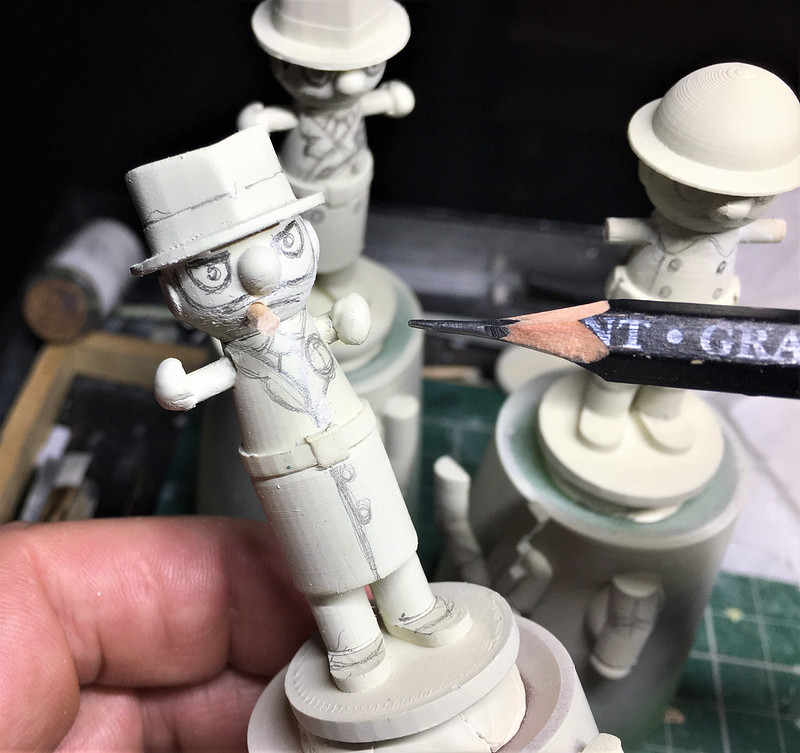
Above: When I say that priming creates a canvas onto which I apply my painting
I mean this literally, I sketch out my character's features using pencil.

However, lately I have been experimenting with a third type of primer - the 'filler/primer', also known as putty primer. Now this is quite thick and gloopy - like a liquidised putty. It can also be what is known as 'self-levelling' which is a primer that is formulated to level out evenly over a surface as it dries, providing a smooth finish.

This is great for covering both the aggressive wood grain I sometime get with the cheap wooden pegs I use AND can be useful for helping alleviate the 3D printing texture I get when making my 3D printed peg figures.

This sound great BUT, a word of warning, this stuff - by definition - is extra thick! Being heavy handed or too close to your model when spraying can result is over-coverage which can easily cover details that you actually want to be seen! In this case you end up having to sand back the excess primer to uncover lost detail.

So, there you having it. Priming. Not rocket science but there are some considerations you should be aware of. I love this stage and I even like the look of my primed models, it's great when I get to this stage as it marks the start of the FUN!

Above: And the painting begins!

Sunday, 7 March 2021

1920s Peg Detective - Part 1

Another in my 'Assault on Innsmouth' series, this character is a Federal agent. It's been a while since I read 'Shadow Over Innsmouth' but as far as I remember Lovecraft relates that Innsmouth was eventually assaulted by Federal forces to clear out the degenerate elements which was mis-reported by the press as a 'prohibition liquor raid'. While this is - as far as I remember - fairly unspecific later narratives in the 'Call of Cthulhu' RPG mythology intimate US Marines, US Navy and government agencies like the FBI being involved.

Now the 'Federal' agencies may have been one of any number, like The Bureau of Internal Revenue, The Federal Bureau of Investigation or even - as pictured above - The US Postal Inspection Service, all of which - despite the mundane titles of some of these services - had a hand at dealing with the gangsters and miscreants of the time.

So, as I cannot be exact as to which department might have had a hand in the raid, my agent is a generic government agent (though I had in mind the 1987 movie 'Untouchables' when I made him).

“Arm your agents, and not just with revolvers. If these gangsters want to use machine guns, then give your special agents machine guns, shot guns, tear gas, everything else! This is war!” Bruce J. Gregory (Addison Richards), 'G'Man', 1935. 

The Makings of a 'G' Man...
As is usual with my peg figures I start by planning the hat - a hat is one  of the most identifiable characteristics of my cartoon figures. The hat most associated  with a detective from the 1920s and 30s was the fedora so that's where I started...

Obviously, to match the look of my cartoon figures I simplified the design of the hat by using basic geometric shapes to create something which looked roughly like the real thing (very roughly)! 😄

I also extended the 'body' of my peg figure to give it the look of having a long coat, another characteristic of the hardboiled detective - where would the gumshoe be without his trench coat?

And finally, as an active member of a armed raid I decided to give my man a pump shotgun - again very much influenced by the movie 'Untouchables'...

Above: My completed 3D 'kit' for my peg detective.

Quite a lot of the final detail will be affected during the painting process - such as the shirt, tie and the coat lapels. But, in the meantime, here's the assembled 'kit'...


As usual I did have a bit of a quandary over how to create a acceptable pose with a weapon. My way of making the peg figures does have certain limitations when it comes to modelling 'realistic' poses, particularly when it comes to the arms. So, I have to take a bit of 'artistic licence'... 😉

In this case, as you can see, I have my G Man holding his pump shotgun one handed, it's a bit iffy BUT is in keeping with some Hollywood movies!

NEXT: What colour is a dirty Macintosh? 😂

Thursday, 4 March 2021

US Navy Shore Party Seaman - Part 1

 Onward and upwards with my 'Assault on Innsmouth' characters! Today I've been working on the second of my six 'good guys', this time a sailor with a honking great BAR (Browning Automatic Rifle)!

Above: My reference source for this figure, illustrations of 1920s era
USN Shore Party members from the China campaign.

I've kinda split my investigative team into two types of members - three are the traditional action hero types there to deal with the physical adversaries and traditional dangers, while the other three are paranormal specialists who are adepts in arcane knowledge. (Though in common with D&D conventions each individual will have their own specialist attributes.)

My seaman will be my 'tank', a very physically strong character who possesses heavy firepower and can soak up punishment. His BAR light machine gun will provide the investigative team with protection from waves of aggressors.

Hello Sailor!
I started with my stardard 3D peg figure, though I have now tried to incorporate a belt so as to make painting a little easier (gluing on a belt - plasticard strip - to the printed body proved a little fiddly and messy in previous figures).

Above: My 3D model file was created using TINKERCAD and I am slowly
creating a collection of interchangeable standard parts.


I was thinking about what other items I could add, but in keeping with my simplified cartoon style of my peg characters I decided 'less was more' and that other details were better just painted on.

So, the main new feature of this particular character would be the sailor's Browning Automatic Rifle (BAR) which the US military used as a light machine gun. I wanted a roughly identifiable silhouette though it would still be designed to compliment my simplified 'toy' style. I began by laying down some simple blocky shapes in TINKERCAD (using my standard rifle model as a template for size)...

Above: You can see how TINKERCAD uses simple 'primitive' shapes to
build up your model designs. I wanted to create a rough overall shape that
was analogous to the real BAR but which fitted my 'cartoon' characters.

It actually took a couple of attempts before I came up with a design I was happy with, and I noticed that for these figures that I have sorta over-scaled the guns, I suppose in keeping with the chunky cartoon aesthetic. 

The gun done I printed out all the individual parts to make my peg figure 'kit'...

The only thing that was missing rom this set of components is the connecting rod which acts as the arm attachment 'shoulders'. This I would make out of 4mm wooden dowel (I tried out 3D printing this part but - in my opinion - it was a bit of a waste of time and material when a bit of dowel was perfectly adequate).

NEXT: In part two of this project I'll come up with my paint palette for this little seaman (and I am quite pleased with myself for getting right through this post without making any puns about seaman).

Tuesday, 2 March 2021

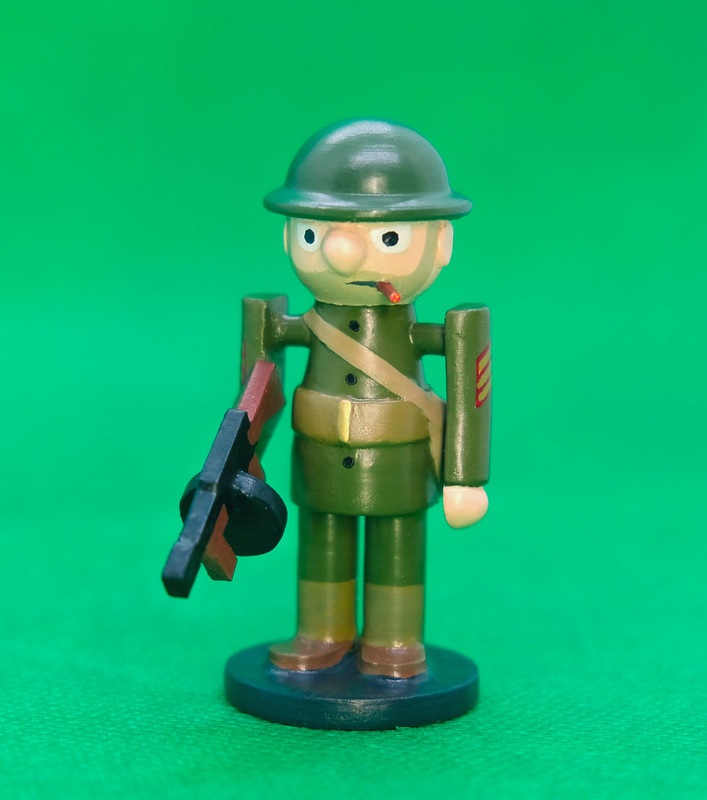
1927 US Marine with Tommy Gun

 First of my 'good guys' for my Assault on Innsmouth' series, 'Sarge' is the lynch-pin of my little RPG team. Hopefully, you will be somewhat familiar with the mythos of H. P. Lovecraft but if not think of a darker version of Scooby-Doo with lots of tentacles involved! (LOL - I simplify a lot here!) 😂

Anyway, I simplified the 1920s era USMC uniform a bit but I think it's been done in the right spirit. I'm really quite interested in this Inter-War period of the 1920 & 30s as it has a lot of potential for Pulp/Steampunk sci-fi and horror tabletop game scenarios.

I quite like this figure, he has a lot of character and it did tempt me to make a whole squad made up of marines turning a Lovecraftian scenario into a sort of retro 'Aliens' bug hunt! 😆 But, in the end, I'm sticking to my original idea of making a more diverse investigative team.

Starting to get a small army of peg figures - going to have to start looking at getting a display cabinet of some type.


Glad I decided to add the cigar!

Sunday, 28 February 2021

New Project - 'Assault on Innsmouth' Intro

 Just a very quick introduction to my new figure set project (now I've finally gotten my mojo back after my furious Christmas flurry). 😊

Introduction to Innsmouth
For those of you unfamiliar with the Mythos works by H. P . Lovecraft here's a very brief account of the scenario which my new project is based upon:

The Esoteric Order of Dagon was the primary religion in Innsmouth after Marsh returned from the South Seas with the dark religion circa 1838. It quickly took root due to its promises of expensive gold artifacts and fish, which were desired by the primarily-fishing town.

The central beings worshipped by the Order were the Father Dagon and Mother Hydra, and, to a lesser extent, Cthulhu. Dagon and Hydra were seen largely as intermediaries between the various gods rather than as gods themselves. Even so, the cultists sacrificed various locals to the Deep Ones at specific times in exchange for a limitless supply of gold and fish. When they ran out of locals, they would go to other places to kidnap people to be sacrificed. Eventually, things became so bad that the US government sent the police force to apprehend Marsh and his cult. [Wikipedia.]

Above: The raid on Inssmouth from Osprey Publishing's 'The Cthulhu Wars'.

My figure set will include two groups of six figures, one set made up of the 'Federal Forces' who made the assault on Innsmouth and the other representing the citizens of Innsmouth. I hope to use the figures in a tabletop RPG mini-scenario pitting one force against the other.

On With the Good Guys!
As usual there will be figures which might be considered 'the good guys' and those some might consider 'the bad guys'. I leave the matter for others to argue over but for ease let's start with how I intend to make up the 'good guys'!

The first thing to consider is the 'historical' period we are talking about - in the Lovecraft mythology the raid on Innsmouth is said to have been taken place in 1927. This is a rather interesting as I have always wanted to do an 'Inter-War' years project based on H. G. Wells 'Funny Little Wars' rules intermixing historic military with a Science fiction/horror cross-over.

So, all the figures will be of this late 20s pulp style...

The Federal Assualt Team:
- USMC Sergeant armed with a Tommy Gun.
- USN Landing Team seaman armed with a B.A.R.
- FBI/Treasury Agent armed with pump shotgun.
- Photographer/Journalist with camera to record event.
- 'Priest' - though I am still a bit uncertain about this character.
- Lead Investigator - Some sort of professor, again a bit undecided.

For sources from which I can make my scenario I am using Osprey's 'Cthulhu Wars' for background and am trying to local a copy of 1992 Chaosim's 'The Raid on Innsmouth' for hints on how to run the game. But this is a work in progress.