Getting back into FLW Toy Soldiers has been a little more convoluted and slow going than I expected. Even before I picked up a little soldier I had to begin to reorganise the complete mess that is my 'man cave' (stroke home junk yard). But, the good news is I can actually see some carpet now, though the mountain of boxes of 'crap' I've moved to one side of the room is threatening to avalanche on top of me every time I venture upstairs!
However, I did manage to dig out a couple of hibernating projects and I have managed to make some progress with them. So, here's what's on my workbench (come TV Dinner tray) at the moment...
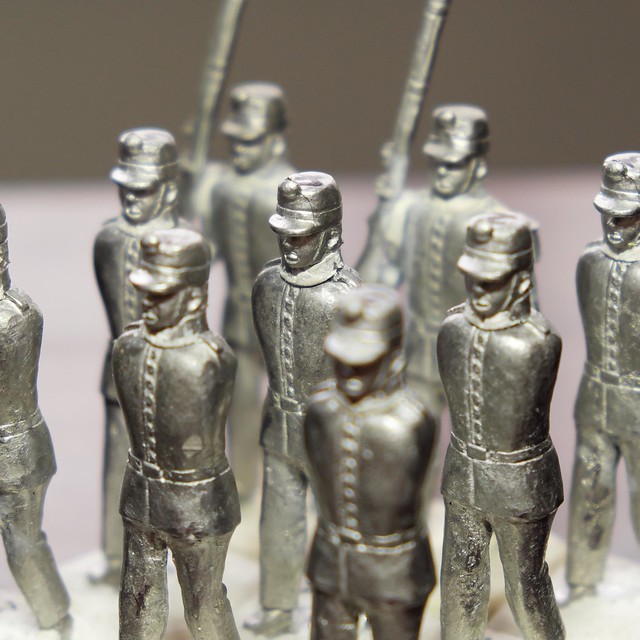
1890 French Infantry of the Line
I do love my little Belle Époque French soldiers - Black Hat mouldings - and I'm really pleased to get this little half-regiment back on the march again.
They are a tiny bit taxing as there is a reasonable amount of preparation work to be done on these white metal figures. The fit is a wee bit of an issue, and pitting is the other. I've had to resort to the liberal use of white Milliput putty to fill in and smooth out some of the gaps and holes. But hey, that's white metal models for you!
Faux 1900 Heavy Artillery
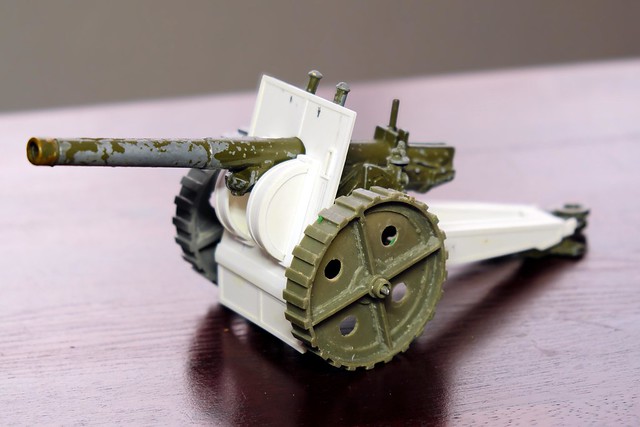
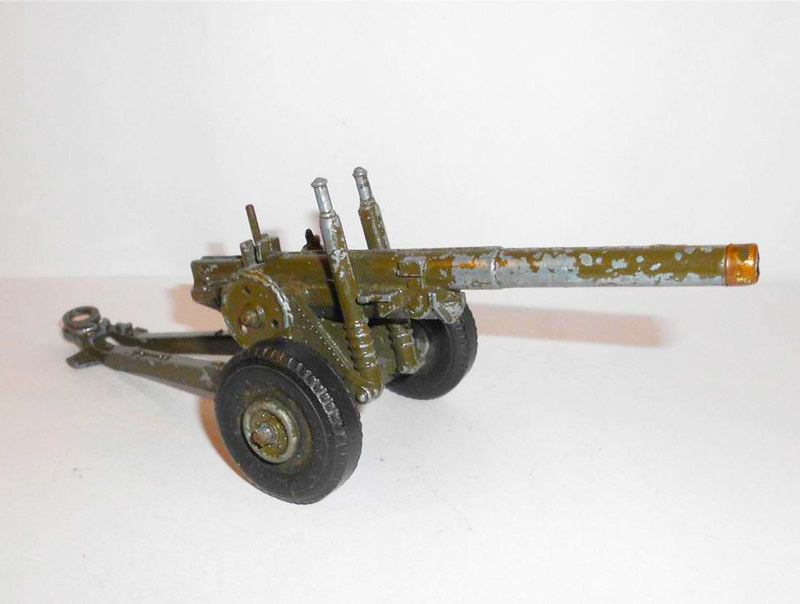
I also dusted off my 'poor man's Britain's Gun'. This die cast model - by Crescent - is actually a WW2 era 4.5 inch gun, but I'm modifying it to make it look more like a turn of the century piece.
The whole reason for doing this is so I can paint this gun in 1890 Molatero artillery colours (black and white). And while I already have two examples of the lovely Britain's 3.5 Naval Gun model, I do not want to desecrate either of these by painting them. (Crescent die casts are cheap and widely available on eBay.)
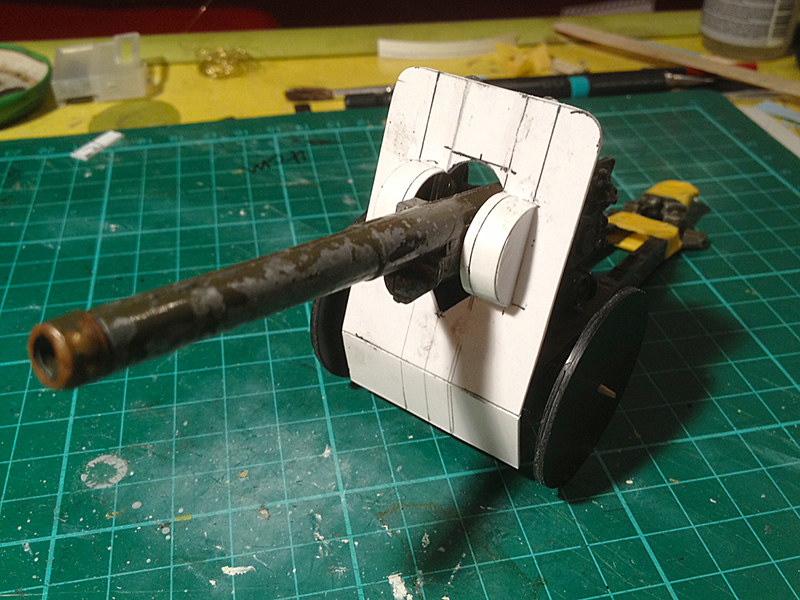
I'm just working on fixing the scratch built gun shield onto the model's chassis. And then - once I know all my plastic parts fit correctly - I will remove them again and begin to strip the green paint off the metal model.
Being the Ethereal Embassy for the Kingdom of Molatero and it's participation in the Funny Little Wars
Showing posts with label Crescent. Show all posts
Wednesday, 15 March 2017
Tuesday, 16 April 2013
FLW - Poor man's 4.7 Naval Gun Part 5
Dispatch from the Burkish Ministry of War: Today representatives of the Burkish General Staff visited the armament works of Ware-Armatage in England to oversee the progress of the very latest heavy artillery to be procured for the Pasha's Grand Expeditionary Force. This weapon will undoubtedly consolidate the already enviable reputation of the Burkish Marine Infantry and constitute a fearsome force, one that will bolster the Army of Molatero in it's quest for peace and security.
| The Pasha - treasured friend and strong ally of Molatero |
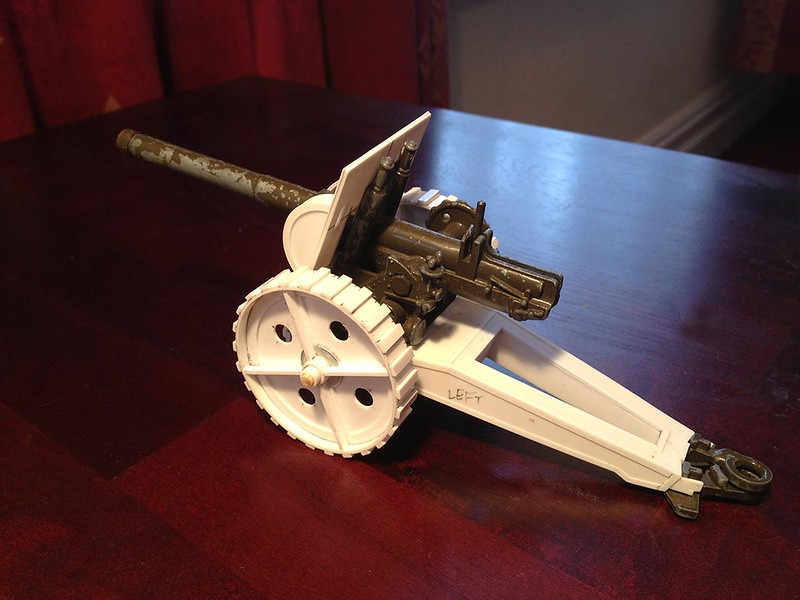
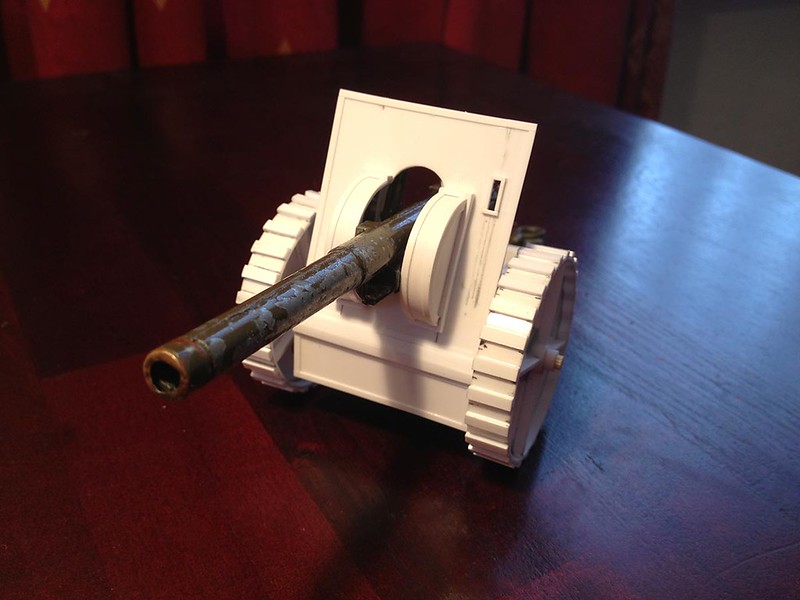
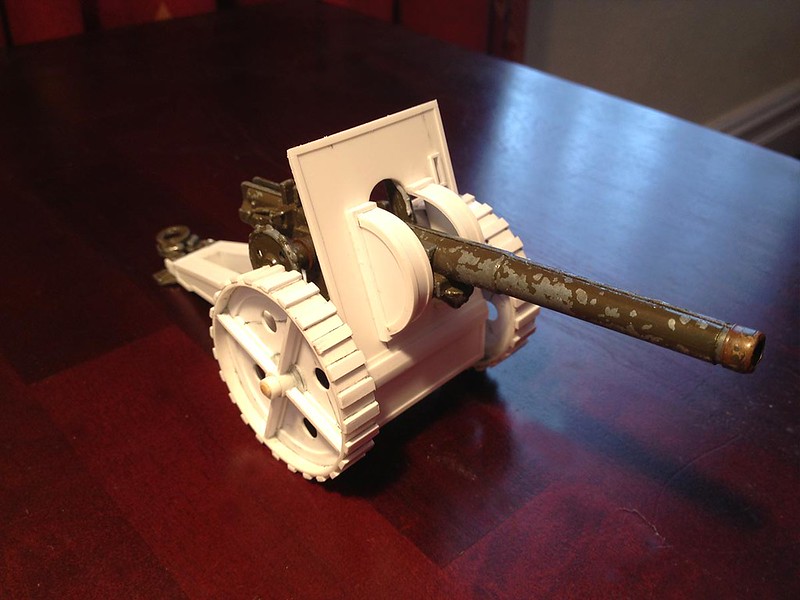
I've finished the plasticard 'disguise' for my conversion project. I decided not to go over the top with detail - it would be all to easy to start banging on rivets and what-not.
I'm really pleased with the boxing-in job I did with the original split carriage. It changes the character of the gun all-together and makes it more early 1900s looking (I think). The wheels obviously help a lot too in this respect.
One thing I did notice - now I do have an actual Britains' 4.7 gun model - is the discrepancy in scales between Britains and Crescent Both are suppose to be 1/32 - I believe - but the Crescent's 5.5 inch gun is a lot more slender than the Britains' 4.7 inch gun. So I may have to dub my poor man's 4.7 as a poor man's 4 inch gun instead!
Anyway, job done and now it's onto the renovation of the Crescent toy itself. I want to strip off the old paint and give it a new coat of Humbrol N0. 50 Brunswick Green and then paint my plastic parts to match. Then it's a case of putting the two together.
Labels:
artillery,
conversion,
Crescent,
die-cast,
Project 1
Wednesday, 3 April 2013
FLW - Poor man's 4.7 Naval Gun Part 4
| The Crescent 5.5 gun with it's split carriage opened and ready to fire |
At this point the single piece carriage was the norm and the Britains' 4.7 gun reflects this, so my faux 4.7 should have this feature.
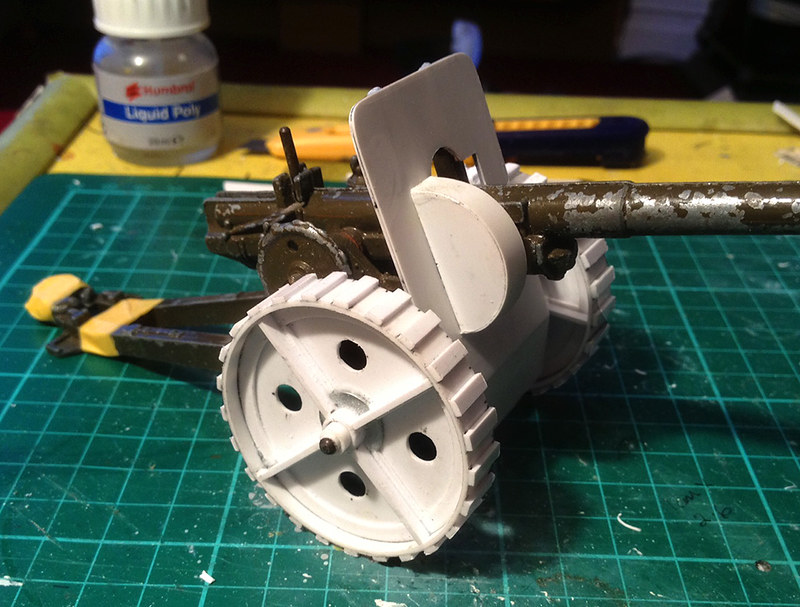
Basically I will be hiding the 5.5's split carriage by covering it in a plasticard shell, boxing it in to give the impression of an Edwardian heavy gun carriage. I'll let the photos tell the story...
Of course I will tart this basic box up a bit with some additional detail, but I will show this at the final put together. You'll notice I have already started to disassemble the Crescent toy ready for the next stage where I repaint it, I'll use the Nitromors to strip the old paint first.
Labels:
artillery,
conversion,
Crescent,
die-cast,
Project 1
Sunday, 24 March 2013
Poor man's 4.7 Naval Gun - Part 3
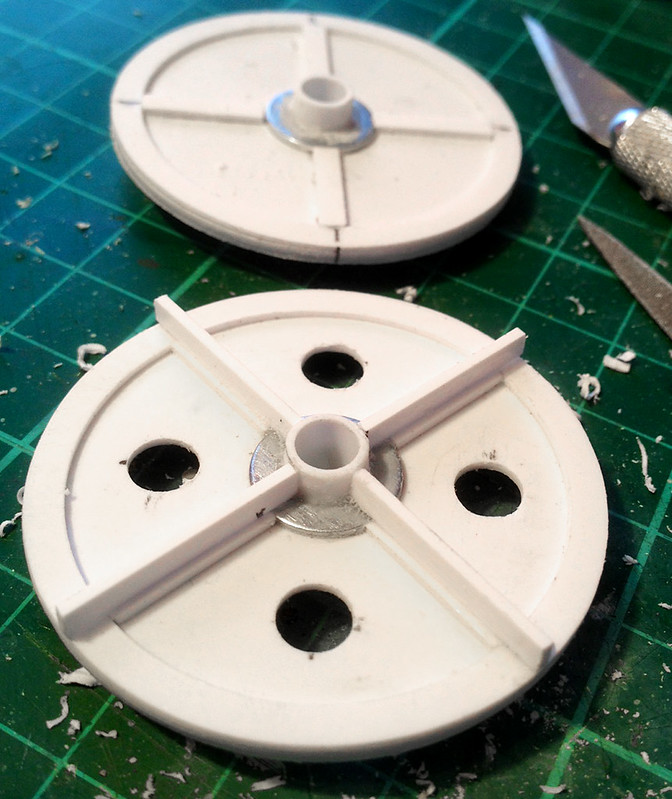
Last Sunday I prototyped my new shield design for my Crescent 5.5 gun conversion, today I have been finishing off my new wheel design. I wanted a 1900s style solid wheel design - a 'Percy Scott' style - similar to that on the classic Britains' 4.7 Naval Gun which I am modelling my conversion on.
I started off by making some plasticard discs and then added the additional bracing and hubs. I used a few spare metal washers to add some strength, and also because they happened to be the exact size I was after.
Then I cut out a couple of strips of plastic to form the rims of the wheels and glued them to the outside of the discs. I suppose this was one of the trickier bits as curling the plastic around the discs was a bit fiddly.
I am rubbish at maths - I am more the visual type of guy - so I worked out the diameters and spacing of everything by trial and error. Making a paper template which I could wrap around the wheel as a make-shift ruller for marking my wheel tred measurements...
The Britains' 4.7 didn't have any treds on it's solid wheels, but I liked this idea, I think it's evocative of the period. Besides, I don't want my '4.7' to be exactly the same as the Britain's one, just similar.
In the end I didn't bother faffing around with complicated methods of dropping the axle height (to match the Britain's gun) I just decided that this height was acceptable.
Next I will box in the tail supports and then figure out how to disassemble the Crescent gun ready to strip of the original paint prior to repainting the complete conversion.
I started off by making some plasticard discs and then added the additional bracing and hubs. I used a few spare metal washers to add some strength, and also because they happened to be the exact size I was after.
Then I cut out a couple of strips of plastic to form the rims of the wheels and glued them to the outside of the discs. I suppose this was one of the trickier bits as curling the plastic around the discs was a bit fiddly.
I am rubbish at maths - I am more the visual type of guy - so I worked out the diameters and spacing of everything by trial and error. Making a paper template which I could wrap around the wheel as a make-shift ruller for marking my wheel tred measurements...
The Britains' 4.7 didn't have any treds on it's solid wheels, but I liked this idea, I think it's evocative of the period. Besides, I don't want my '4.7' to be exactly the same as the Britain's one, just similar.
In the end I didn't bother faffing around with complicated methods of dropping the axle height (to match the Britain's gun) I just decided that this height was acceptable.
Next I will box in the tail supports and then figure out how to disassemble the Crescent gun ready to strip of the original paint prior to repainting the complete conversion.
Labels:
artillery,
conversion,
Crescent,
die-cast,
Project 1
Sunday, 17 March 2013
Poor man's 4.7 Naval Gun - Part 2
Well, I started the weekend with Friday's post about my intended 'Poor man's 4.7' project and today I end the weekend with a little update on my progress. I've finished off the gun shield prototype - it's a little lacking in detail (rivets and what-not) but I will save that for the final version.
One problem I had to solve was the Crescent 5.5 model's elevation mechanism as bits of it jut out at the front, interfering with my shield. So I cut out a section of my shield to allow the gun to elevate freely...
Trouble is that this means that I have rather a large hole in my shield now. So I designed a set of cowls to cover the holes but still allow the gun to rise and descend...
I think this gives the shield the Edwardian period look I was after, but I will be happier when I have the rest of the detail done. One of the things I want to do is to make a telescope like the Britains' 4.7 - I think it will finish this off nicely...
Next I'll make my wheels - I think I have come up with a way to make bigger wheels without raising the gun any higher.
One problem I had to solve was the Crescent 5.5 model's elevation mechanism as bits of it jut out at the front, interfering with my shield. So I cut out a section of my shield to allow the gun to elevate freely...
Trouble is that this means that I have rather a large hole in my shield now. So I designed a set of cowls to cover the holes but still allow the gun to rise and descend...
I think this gives the shield the Edwardian period look I was after, but I will be happier when I have the rest of the detail done. One of the things I want to do is to make a telescope like the Britains' 4.7 - I think it will finish this off nicely...
Next I'll make my wheels - I think I have come up with a way to make bigger wheels without raising the gun any higher.
Friday, 15 March 2013
Poor man's 4.7 Naval Gun - Part 1
I decided to designate Friday's as my Funny Little Wars day (blog wise), just so I end the week with something a little more frivolous. I really enjoy the tongue in cheek aspect to this war gaming format as it encourages an imaginative approach within a loose framework of Edwardian military history.
Today I am starting to consider how I might add a battery of heavy artillery on the field. Usually the avid FLW exponent would by default turn to the famous Britains' 4.7 inch Naval Gun toy. It was H.G. Wells' favoured 'weapon' on the playroom battlefield and it holds a rather hollowed place among those that use his rule set. But today a authentic 4.7 model will set you back a tidy sum as they are being snapped up by collectors.
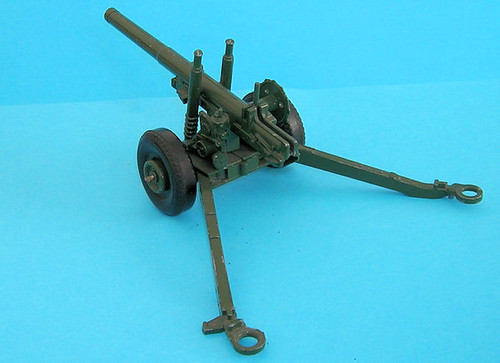
So I decided to try and come up with a cheap and cheerful alternative to the venerable 4.7. I soon discovered the Cresent Models 5.5 inch British artillery piece, another die cast toy but one that does not have the charm and charisma of Britains' masterpiece.
The 5.5 gun can be picked up for a pitance - compared to the 4.7 - on eBay and there are plenty on offer in a variety of conditions. My only stipulation was that the firing mechanism was in a working condition and I soon won one at a very reasonable price.
Now the 5.5 is a relatively modern gun compared to the 4.7 (which historically dates back to the late 1880s) so I realized that if I were to pass my model off as an Edwardian artillery piece I would have to disguise it somewhat.
First thing to go were the very modern looking rubber tyres and thier wheels. An easy job that only entailed my pinching the end of the axel so that the steel pin that formed the axel slid through the retaining holes. Job done (nice easy start)!
To replace the 5.5's wheels I wanted to create something more fitting to the period (pre-WW1) and have something that was a little larger. I also wanted to add a gun shield, to hide the huge spring posts and add to the 'antiqued' look.
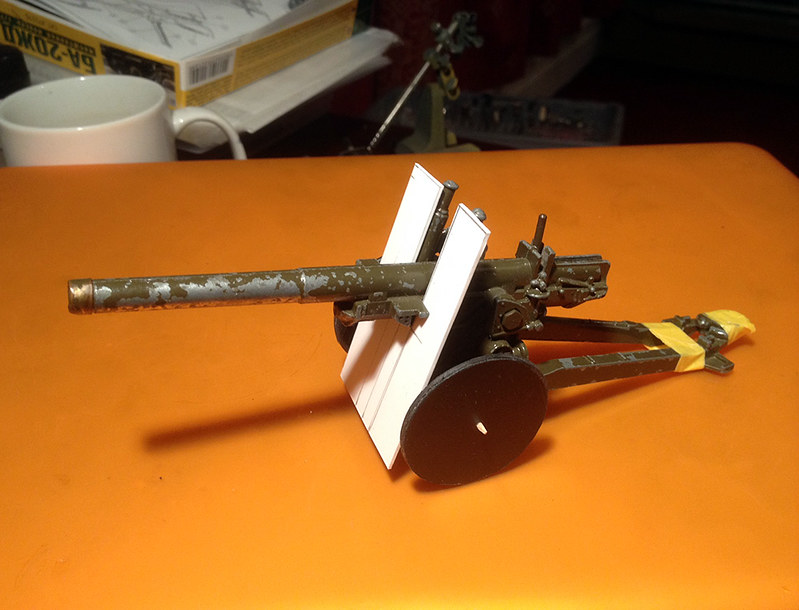
None of what I am doing is irreversible so that - if I wish to - I can turn my faux-4.7 back into it's original 5.5 self. The upshot of my rough and ready prototyping is this...
Now this is, of course just a very elementary 'proof of concept'. I wanted to check what size of wheels I could get away with and also to see how I might affix a shield without obstructing the ability to elevate the gun. I also taped the gun's tail supports together and intend to box them up with plasticard to give a more '4.7' looking carriage to my model.
Naturally, once I am satisfied that I have the proportions that I am looking for in my add-on components I will craft some new parts which have a bit more detail and realism to them. But even at this point I think my additions have change the character of the gun slightly.
I think I can get away with slightly larger wheels and my final versions of these will either have a spoked arrangement or a 'solid' design like the Britains' 4.7 gun has...
Today I am starting to consider how I might add a battery of heavy artillery on the field. Usually the avid FLW exponent would by default turn to the famous Britains' 4.7 inch Naval Gun toy. It was H.G. Wells' favoured 'weapon' on the playroom battlefield and it holds a rather hollowed place among those that use his rule set. But today a authentic 4.7 model will set you back a tidy sum as they are being snapped up by collectors.
The 5.5 gun can be picked up for a pitance - compared to the 4.7 - on eBay and there are plenty on offer in a variety of conditions. My only stipulation was that the firing mechanism was in a working condition and I soon won one at a very reasonable price.
Now the 5.5 is a relatively modern gun compared to the 4.7 (which historically dates back to the late 1880s) so I realized that if I were to pass my model off as an Edwardian artillery piece I would have to disguise it somewhat.
First thing to go were the very modern looking rubber tyres and thier wheels. An easy job that only entailed my pinching the end of the axel so that the steel pin that formed the axel slid through the retaining holes. Job done (nice easy start)!
To replace the 5.5's wheels I wanted to create something more fitting to the period (pre-WW1) and have something that was a little larger. I also wanted to add a gun shield, to hide the huge spring posts and add to the 'antiqued' look.
None of what I am doing is irreversible so that - if I wish to - I can turn my faux-4.7 back into it's original 5.5 self. The upshot of my rough and ready prototyping is this...
Now this is, of course just a very elementary 'proof of concept'. I wanted to check what size of wheels I could get away with and also to see how I might affix a shield without obstructing the ability to elevate the gun. I also taped the gun's tail supports together and intend to box them up with plasticard to give a more '4.7' looking carriage to my model.
Naturally, once I am satisfied that I have the proportions that I am looking for in my add-on components I will craft some new parts which have a bit more detail and realism to them. But even at this point I think my additions have change the character of the gun slightly.
I think I can get away with slightly larger wheels and my final versions of these will either have a spoked arrangement or a 'solid' design like the Britains' 4.7 gun has...
Above: The real thing -Photograph showing British QF 4.7 inch gun on the improvised
wooden field carriage designed by Captain Percy Scott. In action at the Battle of Colenso, South Africa, 15 December 1899. Source: Wikipedia
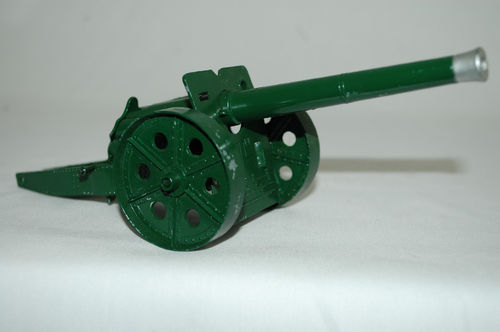
Above: The famous Britains' model number 1264. 4.7 Naval Gun. This die cast toy
was in production for some 60+ years, from 1905. It went through several versions, the
mechanism being improved and honed.
was in production for some 60+ years, from 1905. It went through several versions, the
mechanism being improved and honed.
Subscribe to:
Posts (Atom)